Showing posts with label Walter Pidgeon. Show all posts

Sunday, 25 January 2015

Matt's Big Oscar Challenge Days 372-374: Days of Future Past Part Four

We rewind once again and this time embark on a journey through three films that were nominated for Best Picture during the 1940s.

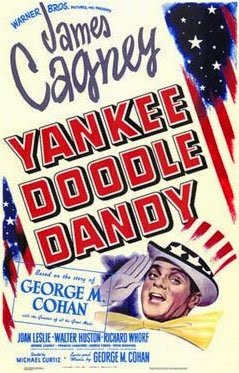
We kick off with an Oscar favourite; a biopic in the form of Yankee Doodle Dandy which focused on the life of composer and showman George M. Cohan. As somebody who wasn't particularly familiar with the name the only thing that drew my eye to the film was the title itself. Indeed, it was later revealed to me that Cohan wrote a number of patriotic songs including 'Over There' which was played to honour the men serving in the First World War. Yankee Doodle Dandy's patriotic nature meant that it had a lot in common with the last 1940s film I watched, Sergeant York. Both were flag-waving endeavours, both starred Joan Leslie as the female lead and both won the award for Best Actor. However I felt that James Cagney's portrayal of Cohan was miles better than Gary Cooper's turn in Sergeant York the previous year. Cagney captivated the screen throughout proving himself to be a fine theatrical presence but also was able to add more pathos to the role when the script required it. The musical numbers that were scattered throughout Yankee Doodle Dandy helped me to understand just why Cohan deserved to have a whole film devoted to him. If I have once criticism of Yankee Doodle Dandy, it's the linear approach that screenwriters Robert Buckner and Edmund Joseph employ. The film sees Cohan narrate his life story to President Roosevelt in a manner that I found quite dry although the musical aspect of the piece more than made up for it. Ultimately I found Yankee Doodle Dandy to be a rather easy watch which was bolstered by a blistering turn from James Cagney.
Nominated alongside Yankee Doodle Dandy in 1943 was Kings Row, a film based on the novel by Henry Bellamann about a number of youngsters growing up in a small town. The film begins with meeting the five characters we'll be spending time with as schoolchildren, which in a way helped to understand their motivations as we saw them grow up in prior years. Among the cast of twentysomethings were Ann Sheridan, Betty Field and a certain whipper-snapper by the name of Ronald Reagan. In fact Reagan's performance as the initially privileged Drake McHugh was possibly the best of the five turns given by the younger cast members. I believe that that has something to do with the fact that McHugh has the most to deal with from losing his inheritance to having his legs lopped off by a sadistic surgeon. As you can tell by that description alone there's a lot of bleak moments in Kings Row including suicide, murder and mental illness. I feel the melodramatic tone of Kings Row was what put me off it especially seeing as the three female members of the cast gave incredibly hammy turns. Erich Wolfgang Korngold's score was similarly overbearing and definitely left little to the imagination. At the same time I can't say that I wasn't moved by anything that happened in Kings Row and I discovered that I'd become invested in at least two of the characters. However, I ultimately believe that Kings Row will be one of the films I've watched throughout this challenge that will soon fade from my memory in the coming weeks.

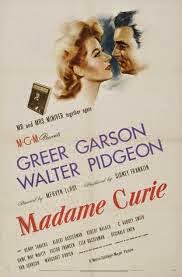
Yankee Doodle Dandy and Kings Row ended up both losing the Best Picture prize to quaint English war yarn Mrs. Miniver which would also see Greer Garson pick up the Lead Actress award. One year later Garson would pair up with her Mrs Miniver co-star Walter Pidgeon for yet another biopic in which would see her portray the brilliant Marie Curie. However the lead characters of Marie and Pierre Curie are the only brilliant things in this really stale and dull biopic. If I didn't know any better I would've thought that Madame Curie had been made in the early 1930s rather than the mid-1940s. There are plenty of things wrong with Madame Curie not least its script which was ridiculously expositional. I wasn't surprised to learn that the script had gone through many rewrites after original scribe Aldous Huxley left the project in 1938. Rather than feeling like a cinematic release, Madame Curie looks like it's been cobbled together as an educational film to inform America's schoolchildren about the discovery of radium. After winning Best Actress the prior year, it appeared as if Greer Garson was exhausted from all the awards ceremonies as she appeared to be simply going through the motions throughout Madame Curie. Walter Pidgeon was slightly better in his role as Pierre; but the pair showed none of the excellent chemistry they shared in Mrs. Miniver and Blossoms in the Dust. One thing you could say in Madame Curie's favour is that it's a thorough retelling of Pierre and Marie's life and work together so if you wanted to know their story this is probably a good starting point. But, apart from being an educational tool, there's very little praise I can heap onto a film which I struggled to watch from beginning to end.

Next time we return to the 21st century and go on a marathon of Best Actor winning pictures.

Friday, 6 April 2012

Matt's Big Oscar Challenge Day 168: It's a Little Bit Funny


So this bank holiday has yielded two films that are on my 1960s list for this Oscar Project with the first being Funny Girl the biographical musical of theatre star Fanny Brice which incidentally was briefly covered in 1930s Best Picture winner The Great Ziegfeld with Brice playing herself. Here Brice is played by Barbara Streisand in her debut film performance, for which she won the Best Actress Oscar, as we see her journey from awkward teenager to star of the Ziegfeld Follies. The story starts with Brice trying to get a part in the chorus but realising that instead she should be a headliner due to her comedy timing and great voice. When she finally makes it she falls in love with Omar Sharrif's Nicky Arnestein with whom she runs off abandoning the Follies. Once he has won lots of money playing cards they return to a big mansion and she returns to the Follies however things take a turn for the worst with Nick's business ventures falling through. After the pair move into an apartment Nick feels that he has to be the man despite Fanny earning more than him so agrees to go through with a shady deal and gets arrested for embezzlement. Fanny and Nick reunite briefly but at the end of the day separate mainly so she can go off and make the sequel.

One of about eight musicals that I have to watch during the next fifty films Funny Girl at least had some bite to it and some very familiar songs. I already knew that Don't Rain on My Parade featured prominently and indeed in the scene in which Fanny decides to abandon the Follies to be with Nick her performance is great as it is on People and all of the other songs featured. The star of the show though is undoubtedly Streisand who is on the ball with all her timing and really convinces as the girl who has a great stage presence but lacks maturity when it comes to her personal life. Omar Sharif is always good as the dashing love interest/caddish villain and in this he plays a version of the two a man who feels like his other half is the one wearing the trousers. The Follies productions are also greatly reconstructed although they don't feel as genuine as in the story of Ziegfeld himself here played by veteran actor Walter Pidgeon. While not everything works and I did find myself a trifle board during some of Nick's card games this was an entertaining musical biopic with a stunning debut performance from its lead actress that was more than worthy of the Oscar she won for it.

Thursday, 14 April 2011

Matt's Big Oscar Challenge Day 116: Keeping the British End Up


As we spirit towards the finish line of the 1940s its time for the last winner of that decade in William Wyler's Mrs Miniver. The film, like Blossoms in the Dust, stars Greer Garson and Walter Pidgeon as a happily married couple and parents to three children, two youngsters and a very upper-class lad called Vin who is off at university when the film begins. In fact Mrs Miniver is mostly about how normal families and indeed normal towns are affected by the war. So for example Vin leaves university to join the RAF meanwhile he also gets married to Carol the granddaughter of the snooty Lady Beldon. Mrs Miniver's husband Clem also agrees to volunteer the best way he can and helps in the Dunkirk evacuation. One of the most shocking parts of the film is where Mrs Miniver finds a German soldier in her house and is held at gunpoint until she provides him with food she then calmly phones the police and he is arrested. There is also a subplot involving a rose grown by the train station controller and named after Mrs Miniver which is entered in the flower show against Lady Beldon, who usually wins it. Beldon announces the winner and sees her name on the card but instead gives it to the station master and the Mrs Miniver rose as again war has changed her. The film though does have a tragic conclusion featuring the death of one of the major characters and a solemn message of the dangers and casualties of war.

For me Mrs Miniver is an odd beast and it doesn't feel like a winner in the way Gone with The Wind, Casablanca or even The Best Years of Our Lives did. One reason for that might be its awfully quaint and middle-class, the village that the Minivers inhabit is one in which everybody knows everybody else and its all lovely and cosy until those awful Nazis come along and ruin everything. I suppose one reason this may have won is because there was very little competition this year and also because it may've been the most accurate depiction of wartime yet. As well as Best Picture and Best Director for Wyler both Garson and Teresa Wright as Carol both won Oscars, again this wasn't my favourite Garson performance that was in Random Harvest but Wright is very good as the young girl married too soon and then having to contend with her new husband off fighting the war. Dame Mae Witty as Lady Beldon, Pidgeon as Clem and Henry Travers as Vin were also nominated and I like the fact that Travers actually later married his on screen mother Garson. There's nothing particularly wrong with Mrs Miniver it's a nice enough film but it just doesn't have anything about it to make a significant impact and make me believe that it should've won Best Picture.

Monday, 4 April 2011

Matt's Big Oscar Challenge Day 111: Doing it For the Kids

There are some films on this list that I read the plot of and I instantly want to watch others I have to force myself and Blossoms in the Dust does definitely fall into the latter category. The film is based around the true story of Greer Garson's Edna and how she overcomes tragedy after tragedy to set up a successful home for orphans until they are rehoused into loving families. The story starts with Edna due to be married to the boorish Damon only for Walter Pidgeon's bank clerk Sam to whisk her off her feet. Meanwhile Edna's adopted sister Charlotte is due to marry her fiancée Allen but is stopped when it turns out that Charlotte was adopted by Edna's parents. Unable to marry the man of her dreams Charlotte commits suicide but that's not the end of Edna's worries. She barely survives giving birth to her daughter only for that daughter to wind up dying about five years later on. After finding out she can no longer have children Edna and Walter set up a home for rehousing orphans which is shut down after Edna upsets one of the more important ladies of the town and the couple up roots and move. Soon Walter takes ill and dies leaving Edna to fight her own battles including one with a lowlife man who wants to get some money from the wealthy couple who adopted his son and Edna also battles to remove the stigma from those children who get adopted so they can live a normal life and not end up like Charlotte. The film ends with Edna successful in her quest but still feeling lonely in life unable to form attachments to any of the children as she knows she won't be around all their lives. Her only constant throughout the film is Max, a doctor who befriends the couple and who is Edna's confidant after Sam dies.

There's really only so much one woman can go through and blimey did Edna go through it all - the death of her friend, her child and her husband not to mention not being able to have children again and being chased out of town. This was one hell of a woman and its nice for her to be recognised but at the same time I feel like the film was just too overly melodramatic for my liking. I do like Greer Garson as an actress, especially in Random Harvest a film she was not Oscar nominated for, but here she fights an uphill battle portraying a character who demands sympathy in every scene and can't seem to catch a break. Walter Pidgeon is fine as the charming caddish Sam but once he starts to get ill he also turns into a bit of wimp and starts talking in wistful terms. In fact my favourite characters in the film were Max the doctor and Zeke the couple's loveable servant who follows them all over the country. Unfortunately if this were released today I still reckon it would get its Oscar nomination because it's one of those dreary heartfelt dramas that Oscar love to acknowledge.

Sunday, 1 August 2010

Matt's Big Oscar Challenge Day 71: Mine All Mine


If I asked which of these films are the least well known - Hitchcock's Suspicion, The Maltese Falcon, Citizen Kane or John Ford's Welsh mining drama How Green Was My Valley. I think most people would say the final film in that list but however that was the film that won at the 1942 ceremony beating those other four films. I would've given it the benefit of the doubt but after watching it I don't think it really deserved the credit it got in terms of its five Oscars. The film deals with the Morgan family as narrated by the youngest son Huw who is recalling his childhood and the various entanglements that his siblings got into. The main theme is old vs. new as the stuck-in-ways old school miner father Gwilym refuses to go on strike his sons, who are fed up of being paid pittance, so the majority of them move out. We are also told the story of Huw's sister who falls for the local preacher who shows kidness to her younger brother, but as he is a man of God and because of the scandal it would cause she marries and older man. However the rumours of a relationship between the two, started by her new husband's housekeeper, sees the sister disgraced and the preacher move away. As Huw grows up he briefly loses the use of his legs after rescuing his mother from drowning but soon recovers and goes away to a school for upper-class boys. Due to his humble origins he is bullied by both the other pupils and the teachers and is taught to stand up for himself by members of his town. The film ends with a large mining disaster in which all members of the family band together to rescue the father from the mine. Although they do pull him out of the mine he dies soon after and Huw recounts his funeral before the adult Huw leaves his family home once and for all.

To give the film its dues, How Green Was My Valley is directed well by Ford who won the Oscar that year and it does have a coherent narrative. There are some impressive set pieces with the mother's drowning and the final mining accident well-crafted and the scenes of family life around the dinner table are also well done. There are also some decent performances Donald Crisp won Best Supporting Actor for his role as the family's patriarch and, as the preacher Mr Gruffyd, Walter Pidgeon was also mightliy impressive as was Supporting Actress nominee Sara Allgood as Huw's sister Beth. However the film just didn't wow me and I found it incredibly ordinary, Roddy MacDowall's Huw got the lion's share of the screen time and wasn't that interesting and the camera work was also fairly mundane. There was nothing very memorable about the film and almost seventy years on from its release it isn't heralded as a classic and isn't even considered one of Ford's best. Also a lot of members of the cast do struggle to get the Welsh accents down with some of them just using Irish instead. I think if nothing else that spoils the film because if you can't do Welsh why be cast as a Welshman in the first place?