Showing posts with label Walter Huston. Show all posts

Sunday, 25 January 2015

Matt's Big Oscar Challenge Days 372-374: Days of Future Past Part Four

We rewind once again and this time embark on a journey through three films that were nominated for Best Picture during the 1940s.

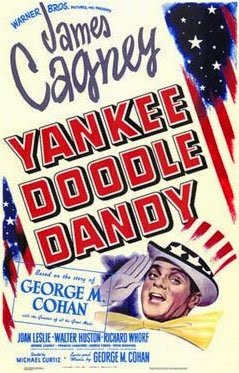
We kick off with an Oscar favourite; a biopic in the form of Yankee Doodle Dandy which focused on the life of composer and showman George M. Cohan. As somebody who wasn't particularly familiar with the name the only thing that drew my eye to the film was the title itself. Indeed, it was later revealed to me that Cohan wrote a number of patriotic songs including 'Over There' which was played to honour the men serving in the First World War. Yankee Doodle Dandy's patriotic nature meant that it had a lot in common with the last 1940s film I watched, Sergeant York. Both were flag-waving endeavours, both starred Joan Leslie as the female lead and both won the award for Best Actor. However I felt that James Cagney's portrayal of Cohan was miles better than Gary Cooper's turn in Sergeant York the previous year. Cagney captivated the screen throughout proving himself to be a fine theatrical presence but also was able to add more pathos to the role when the script required it. The musical numbers that were scattered throughout Yankee Doodle Dandy helped me to understand just why Cohan deserved to have a whole film devoted to him. If I have once criticism of Yankee Doodle Dandy, it's the linear approach that screenwriters Robert Buckner and Edmund Joseph employ. The film sees Cohan narrate his life story to President Roosevelt in a manner that I found quite dry although the musical aspect of the piece more than made up for it. Ultimately I found Yankee Doodle Dandy to be a rather easy watch which was bolstered by a blistering turn from James Cagney.
Nominated alongside Yankee Doodle Dandy in 1943 was Kings Row, a film based on the novel by Henry Bellamann about a number of youngsters growing up in a small town. The film begins with meeting the five characters we'll be spending time with as schoolchildren, which in a way helped to understand their motivations as we saw them grow up in prior years. Among the cast of twentysomethings were Ann Sheridan, Betty Field and a certain whipper-snapper by the name of Ronald Reagan. In fact Reagan's performance as the initially privileged Drake McHugh was possibly the best of the five turns given by the younger cast members. I believe that that has something to do with the fact that McHugh has the most to deal with from losing his inheritance to having his legs lopped off by a sadistic surgeon. As you can tell by that description alone there's a lot of bleak moments in Kings Row including suicide, murder and mental illness. I feel the melodramatic tone of Kings Row was what put me off it especially seeing as the three female members of the cast gave incredibly hammy turns. Erich Wolfgang Korngold's score was similarly overbearing and definitely left little to the imagination. At the same time I can't say that I wasn't moved by anything that happened in Kings Row and I discovered that I'd become invested in at least two of the characters. However, I ultimately believe that Kings Row will be one of the films I've watched throughout this challenge that will soon fade from my memory in the coming weeks.

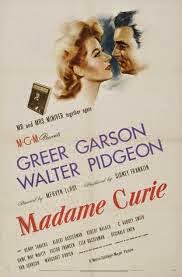
Yankee Doodle Dandy and Kings Row ended up both losing the Best Picture prize to quaint English war yarn Mrs. Miniver which would also see Greer Garson pick up the Lead Actress award. One year later Garson would pair up with her Mrs Miniver co-star Walter Pidgeon for yet another biopic in which would see her portray the brilliant Marie Curie. However the lead characters of Marie and Pierre Curie are the only brilliant things in this really stale and dull biopic. If I didn't know any better I would've thought that Madame Curie had been made in the early 1930s rather than the mid-1940s. There are plenty of things wrong with Madame Curie not least its script which was ridiculously expositional. I wasn't surprised to learn that the script had gone through many rewrites after original scribe Aldous Huxley left the project in 1938. Rather than feeling like a cinematic release, Madame Curie looks like it's been cobbled together as an educational film to inform America's schoolchildren about the discovery of radium. After winning Best Actress the prior year, it appeared as if Greer Garson was exhausted from all the awards ceremonies as she appeared to be simply going through the motions throughout Madame Curie. Walter Pidgeon was slightly better in his role as Pierre; but the pair showed none of the excellent chemistry they shared in Mrs. Miniver and Blossoms in the Dust. One thing you could say in Madame Curie's favour is that it's a thorough retelling of Pierre and Marie's life and work together so if you wanted to know their story this is probably a good starting point. But, apart from being an educational tool, there's very little praise I can heap onto a film which I struggled to watch from beginning to end.

Next time we return to the 21st century and go on a marathon of Best Actor winning pictures.

Wednesday, 28 July 2010

Matt's Big Oscar Challenge Day 67: A Couple More Bogeys

Okay so I know I've been chastising everyone for not watching some of the classics over the last few days but I'm no saint myself when it comes to missing out on the oldies. In fact I've seen less the ten film from this decade's list including the next two films. Also in the last post we looked at Casablanca, but leading man Humphrey Bogart was a busy boy in the 1940s. After a lot of supporting roles in the 1930s he finally became a big star and was probably the top leading man in that decade. Although he didn't win his Best Actor Oscar, for The African Queen, until the 1950s the 1940s were definitely Bogey's best decade. And recently I watched two of his films from the decade one pre and one post Casablanca and both directed by John Huston.

First up we have The Maltese Falcon, Huston's first film as a director, and a nominee at the 1942 ceremony. In it Bogart plays private detective Sam Spade whose detective partner is shot while on a job tracking a man for a girl whose sister has supposedly run off with him. The man also dies that night and Spade is fingered for both murders and has to find out who killed who. Spade then gets charged with the task of finding a black figure of a bird which turns out to be the titular Maltese Falcon, a jewel encrusted figure which was a gift to King Charles V of Spain from the Knights of Malta. During his investigation Bogart meets the diminutive and excitable Joel Cairo and the large and domineering Kasper Gutman sometimes referred to as the fat man. Cairo is the man who first asks Spade to look for the bird and Gutman is able to explain its significance. Meanwhile Spade finds out that the girl Brigid was also after the bird with the man who was killed. The film then builds to a climax as we try to discover who shot who and who is scamming who and what will Spade do? Bogart's Spade isn't a million miles away from Casablanca's Rick, both characters don't really have an emotional attachment to the item on offer and both would rather no attract trouble. Unlike Rick, Spade is basically after money, although there is a brief spark between him and Brigid its nothing like the Rick and Ilsa romance in Casablanca. The similarities to Casablanca don't end there though as Bogart's co-stars are Peter Lorre (as Cairo) and Sydney Greenstreet (as Gutman), the former played the petit criminal in Casablanca while the latter played the rival bar owner. Greenstreet in fact was nominated for Best Supporting Actor and rightly so as, apart from Bogart, his performance is the film's best, the excellent adapted screenplay was also nominated. What I will say is that this is the first proper mystery film that I've watched since I've been doing this quest. While The Thin Man did have a kind of murder mystery structure, The Maltese Falcon was incredibly involving and very well plotted, I believe that Bogart's performance here at least deserved an Oscar nom but this was the year that How Green Was My Valley walked off with most of the awards and there was hardly anything left for even Citizen Kane.

Bogart returned to Oscar-nominated films at the last ceremony of the decade with The Treasure of The Sierra Madre which did however win Best Director and Adapted Screenplay for John Huston and Best Supporting Actor for his father Walter. The film sees Bogart's Dobbs teaming up with Huston's Howard and Tim Holt's Curtin to find gold in the Sierra Madre mountains in Mexico. Dobbs and Curtin meet as two Americans down on their luck in Mexico and soon decide to seek Gold with the help of old-timer Howard. They soon strike it lucky but there are complications which include the arrival of bandits, a fourth American discovering them and Dobbs' own paranoia and greed. It is the final one of those three that the film ultimately plays on as Dobbs believes that Howard is out to get him and that Curtin plans to short change him later on. In terms of plot that's about it and that's the beauty of the film as it is a study of the human psyche and how much trust we can give our fellow man. This theme is played upon nicely both by the haunting score and by the brilliantly shot close-ups of all three men. The central three performances are all excellent, Bogart really did deserve a Best Actor nomination here as his portrayal of the greedy Gringo Dobbs is an intense and sometimes unlikeable one. Dobbs is definitely different from Bogart's other two roles in this decade and that's even better as we don't really expect a man who's played so many heroes to here play a morally ambiguous character. Walter Huston also does well as the old-timer who's obviously seen men affected by gold in a similar way before, Huston impressed me with his work in Dodsworth so it's nice to see him winning an award while Tim Holt also does well as the upstanding Curtin. The film isn't perfect, it takes a little too long to get started and some of Howard's scenes in the Mexican village should've been quicker but overall this is a masterpiece that shows you don't need a huge story to keep audiences entranced for two hours.

There will be a little bit more bogey before the decade is out but these are definitely two of his defining films and I'm glad that I got to watch both of them for the first time.

Saturday, 1 May 2010

Matt's Big Oscar Challenge Day 29: For What it's (Dods)Worth

And we're into the 30th day of the challenge with the film that garnered the most nominations at the 1937 ceremony, Dodsworth. I actually had never heard of this film before but it is one of the best rated films of the 1930s on imdb and also has a higher rating than that year's winner - The Great Ziegfeld. While Ziegfeld is a sprawling epic chronicling thirty years of one man trying to survive the changing face of the entertainment industry, Dodsworth is a much more personal piece about one man trying to rediscover himself following early retirement and losing his wife. In terms of Oscar history this was also a landmark film as it gave William Wyler, the most nominated director in Oscar history, his first nod. Wyler would later go onto direct three Best Picture Winners but arguably Dodsworth should've won as well. Walter Huston, nominated for Best Actor, played Sam Dodsworth an industrialist who made his fortune in motors but is convinced by his wife Fran not to take a promotion and instead travel around Europe with her. Once on their travels Dodsworth tries to become a new man learning the languages and getting excited by seeing new sights. But early one we learn that Fran has ideas above her station and starts to become bored with Sam instead finding solace in a number of men including Captain Lockheart (an early role for David Niven) and a man named Arnold. Her relationship with Arnold makes her separate with Sam for a time as he goes back to America and she is forced to finish her relationship with Arnold when her and Sam become grandparents. Sam and Fran are briefly reunited but Fran falls in love again this time with a German nobleman and makes plans to divorce Sam. Sam has to stay in Europe to finalise his divorce and ends up in Italy where he encounters Edith who he and Fran met while travelling to Europe. When Fran's new marriage falls through she tries to reconcile with Sam but Sam decides that Fran isn't the woman for him and he would be much happier with the uncomplicated Edith and the last reel of the film sees them together in Italy.

Dodsworth is a multi-layered film, well-written and often subtly acted film it doesn't feature melodrama or big musical numbers or massive set pieces, instead it is a character study about a very simple man and a woman who is worried about getting old and just wanting to have fun elsewhere. The relationship between Sam and Fran is never quite concrete but it is clear he is more in love with her than she is with him, she mainly loves his money and what it can do for her. In my opinion Walter Huston's performance is what holds the film together and he was a lot more deserving of a Best Actor Oscar than Paul Muni in The Story of Louis Pasteur other performances that are notable are that of former silent movie star Mary Astor, in her first major sound role as the divorcee Edith, her first scene in which she meets Sam for the first time is absolutely brilliant and also Maria Ouspenskaya as Fran's perspective mother-in-law the almost monstrous Baroness Von Obersdorf a role that got her a nomination in the first ever Best Supporting Actress category, although I believe Astor should've been in there as well. The film did win one award, Best Art Direction, but deserved so much more. Although Wyler would go onto find larger success directing such classics as Roman Holiday and Ben-Hur, Dodsworth has to be put in that category as it is truly a great film.