Showing posts with label Claude Rains. Show all posts

Sunday, 25 January 2015

Matt's Big Oscar Challenge Days 372-374: Days of Future Past Part Four

We rewind once again and this time embark on a journey through three films that were nominated for Best Picture during the 1940s.

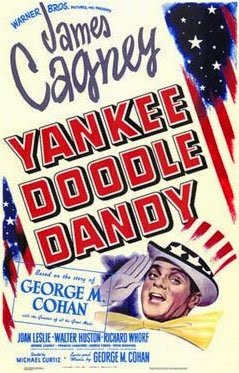
We kick off with an Oscar favourite; a biopic in the form of Yankee Doodle Dandy which focused on the life of composer and showman George M. Cohan. As somebody who wasn't particularly familiar with the name the only thing that drew my eye to the film was the title itself. Indeed, it was later revealed to me that Cohan wrote a number of patriotic songs including 'Over There' which was played to honour the men serving in the First World War. Yankee Doodle Dandy's patriotic nature meant that it had a lot in common with the last 1940s film I watched, Sergeant York. Both were flag-waving endeavours, both starred Joan Leslie as the female lead and both won the award for Best Actor. However I felt that James Cagney's portrayal of Cohan was miles better than Gary Cooper's turn in Sergeant York the previous year. Cagney captivated the screen throughout proving himself to be a fine theatrical presence but also was able to add more pathos to the role when the script required it. The musical numbers that were scattered throughout Yankee Doodle Dandy helped me to understand just why Cohan deserved to have a whole film devoted to him. If I have once criticism of Yankee Doodle Dandy, it's the linear approach that screenwriters Robert Buckner and Edmund Joseph employ. The film sees Cohan narrate his life story to President Roosevelt in a manner that I found quite dry although the musical aspect of the piece more than made up for it. Ultimately I found Yankee Doodle Dandy to be a rather easy watch which was bolstered by a blistering turn from James Cagney.
Nominated alongside Yankee Doodle Dandy in 1943 was Kings Row, a film based on the novel by Henry Bellamann about a number of youngsters growing up in a small town. The film begins with meeting the five characters we'll be spending time with as schoolchildren, which in a way helped to understand their motivations as we saw them grow up in prior years. Among the cast of twentysomethings were Ann Sheridan, Betty Field and a certain whipper-snapper by the name of Ronald Reagan. In fact Reagan's performance as the initially privileged Drake McHugh was possibly the best of the five turns given by the younger cast members. I believe that that has something to do with the fact that McHugh has the most to deal with from losing his inheritance to having his legs lopped off by a sadistic surgeon. As you can tell by that description alone there's a lot of bleak moments in Kings Row including suicide, murder and mental illness. I feel the melodramatic tone of Kings Row was what put me off it especially seeing as the three female members of the cast gave incredibly hammy turns. Erich Wolfgang Korngold's score was similarly overbearing and definitely left little to the imagination. At the same time I can't say that I wasn't moved by anything that happened in Kings Row and I discovered that I'd become invested in at least two of the characters. However, I ultimately believe that Kings Row will be one of the films I've watched throughout this challenge that will soon fade from my memory in the coming weeks.

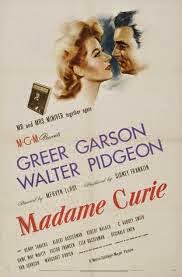
Yankee Doodle Dandy and Kings Row ended up both losing the Best Picture prize to quaint English war yarn Mrs. Miniver which would also see Greer Garson pick up the Lead Actress award. One year later Garson would pair up with her Mrs Miniver co-star Walter Pidgeon for yet another biopic in which would see her portray the brilliant Marie Curie. However the lead characters of Marie and Pierre Curie are the only brilliant things in this really stale and dull biopic. If I didn't know any better I would've thought that Madame Curie had been made in the early 1930s rather than the mid-1940s. There are plenty of things wrong with Madame Curie not least its script which was ridiculously expositional. I wasn't surprised to learn that the script had gone through many rewrites after original scribe Aldous Huxley left the project in 1938. Rather than feeling like a cinematic release, Madame Curie looks like it's been cobbled together as an educational film to inform America's schoolchildren about the discovery of radium. After winning Best Actress the prior year, it appeared as if Greer Garson was exhausted from all the awards ceremonies as she appeared to be simply going through the motions throughout Madame Curie. Walter Pidgeon was slightly better in his role as Pierre; but the pair showed none of the excellent chemistry they shared in Mrs. Miniver and Blossoms in the Dust. One thing you could say in Madame Curie's favour is that it's a thorough retelling of Pierre and Marie's life and work together so if you wanted to know their story this is probably a good starting point. But, apart from being an educational tool, there's very little praise I can heap onto a film which I struggled to watch from beginning to end.

Next time we return to the 21st century and go on a marathon of Best Actor winning pictures.

Monday, 9 May 2011

Matt's Big Oscar Challenge Day 125: Over My Dead Body


A few weeks ago I wrote my review of Heaven Can Wait in it I stated that the 1978 film starring Warren Beatty was a remake of a different Oscar nominated film - Here Comes Mr Jordan which I am next to watch. In the film Robert Montgomery plays the prize fighter Joe Pendleton who crashes his plane on his way to his championship fight as he was too busy playing with his lucky saxophone. He is transported to heaven by one of the many messengers whose job it is to transport bodies from this life to the next however when the messenger tells his boss Mr Jordan about Pendleton's arrival it seems that he is fifty years too early. Jordan, Pendleton and the Messenger then have to find a new body for him as his remains have been cremated by his manager Max. Finally Pendleton's spirit is repackaged in the body of millionaire Farnsworth who has just been murdered by his wife and his business secretary who are conducting an affair. As Farnsworth, Joe falls for the beautiful Miss Logan and helps get her father out of jail before convincing Max that he is still Joe and helping him train 'Farnsworth' up for a prize fight. Before he can carry on his fight Jordan warns him that his time as Farnsworth is up as he gets shot again and this time killed by his wife. Eventually Joe is able to inhabit the body of his rival Murdoch who has been shot by gamblers during his title match. After winning the title Joe as Murdoch is able to tell Max about the murder and Farnsworth's wife is murdered. Jordan than eliminates any memories of Joe from Murdoch's mind but he still hires Max as his manager and goes off with Miss Logan at the end of the film.

Here Comes Mr Jordan is an enjoyable and lightweight comedy whose main strength is its cast. Although his performance is slightly grating at times, Montgomery is fine as the man who keeps jumping from body to body trying to find his identity. However it is Claude Rains' performance as Mr Jordan which really did it for me being both sensitive and charming as well as witty Raines is able to explore his range. Jordan never shouts but is always present when Joe needs some advice this is a good plot device which is used very well. The one thing I had a problem with is there is not enough information about Farnsworth the motivations that his wife wants to kill him apart from his money or the romance with Miss Logan to find myself caring about either of these relationships. However the film mainly is about the bromance between Joe and Max and I found myself really routing for these two to come good and in the end Max got to manage the champion in Joe as Murdoch. While it doesn't really feel like a worthy Oscar contender Here Comes Mr Jordan is an easy watch but at the same it is a little frustrating and wraps everything up very quickly but not as neatly as it wants to but at least its less offensive than the 2001 Chris Rock remake Down to Earth, whether Beatty's remake is better will have to be seen when we get to the 1970s.

Monday, 9 August 2010

Matt's Big Oscar Challenge Day 78: Frank and Jimmy Take on Congress


After watching seven of his films its time to say goodbye to Frank Capra, for his final film on the list its time to go back to the 1940 ceremony and Mr Smith Goes to Washington. The story sees Jimmy Stewart's Boy Scout Leader Jefferson Smith as the surprise choice to take over from the previous senator in his state. Originally the film had been intended as a follow up to Capra's Mr Deeds Goes to Town with Gary Cooper reviving the Deeds role and entering the senate. However when it was revealed Cooper wasn't available Capra decided it would be a perfect vehicle for him to work again with Stewart and Jean Arthur (who had been a couple in You Can't Take It With You). When Smith gets to Washington he is awe-inspired by the architecture and the history that the place has but is ridiculed by the press for being a simpleton. Smith is taken under the wing of Senator Paine, his father's oldest and best friend as well as charming over Arthur's Saunders, Paine's Chief-of-Staff. Smith proposes a new legislation to approve a government loan to allow for some land to be purchased in his state for a national Boy's Camp, and the loan will be paid back by donations from the scouts. Paine is leaned on by the manipulative political adviser Jim Taylor to quash Smith because the land is already part of a dam-building scheme constructed by Taylor. Paine decides to make out that Smith owns the land and is defrauding the scouts but by this stage Saunders is on Smith's side and uncovers Taylor's corruption. The film's most famous scene is where Smith decides to embark on a filibuster, holding the floor and speaking for as long as possible without sitting down, when all the senators leave the room. Taylor and Paine try and break his spirit by rigging the press in Taylor's state and making out that no-one is supporting him but he finds solace in a smile from the senate's president. At the end of the film Smith collapses from exhaustion and Paine tries to commit suicide when he is stopped he confesses everything and Smith's reputation is redeemed.

Just like with Stewart and Capra's most famous colaboration, It's a Wonderful Life, Mr Smith Goes to Washington is remembered for its final scenes. However before that there is a lot that no-one ever thinks about including the scene where Smith tries to punch a lot of journalists after they diss him and Smith's romance with Paine's daughter which is used as a distraction for Smith's plans. However there is a lot to like here, Capra's themes of the underdog triumphing is possibly at its most blatant here with the innocent and ultimately good Smith gets one over on the cowardly Paine and the tyrannical Taylor. Jean Arthur again proves that she is the most consistent of Capra's female leads, with Saunders she portrays a woman trying to survive in a masculine world and has almost lost all her femininity to do so. In fact there is no romantic end to her relationship with Smith however her greatest moment is when someone calls her Clarissa, her first name, which makes her feel somewhat human. Stewart himself is able to play a real, likeable if innocent character with ease. While there are some fine supporting performances from Claude Rains as the multi-layered Paine and Edward Arnold as the just plain evil Taylor. Rains, Stewart and Harry Carey (as the president of the senate) were all nominated for Oscars although none were successful. Indeed only the story won an Oscar but it did come up against Gone With The Wind, I reckon if it had been released a year before or after it may have done better. Although this is more than a fitting end to my Frank Capra education.

Tuesday, 27 July 2010

Matt's Big Oscar Challenge Day 66: You Must Remember This


At the 1944 Oscar ceremony, ten films were nominated for Best Picture, this was the last time this would happen until 2010. The film that triumphed that year was obviously one that is still hailed as a classic that is Casablanca. Those who haven't seen Casablanca, and I will stop chastising people for not seeing these films, will still know lines from it 'here's looking at you kid', 'of all the gin joints in all the world she had to walk into mine' and 'Louis, this could be the start of a beautiful friendship'. There's also the 'Play it Again Sam' quandary as that line doesn't appear in the film when Bogart tells piano player Sam to play 'As Time Goes By', the song which also is something that people would associate with the film. The basic plot concerns people stuck in Casablanca trying to travel from Nazi occupied Europe to the neutral Lisbon and then on to America. Our central figure is Humphrey Bogart's Rick who is seemingly uninvolved in all the struggles that are going on around him and instead is happy to take people's money whether they be Nazi officers or those trying to escape. The item that keeps the plot moving are letters of transit, documents which let whoever holds them travel freely around Europe, which end up in Rick's possession after they are handed him by a petit thief who is arrested by the Nazi Officers. Rick's former love Ilsa, played by Ingrid Bergman, comes into his bar and back into his life after the two had a fleeting romance in France years earlier. Ilsa along with her husband Victor are another couple trying to leave Casablanca and is after letters of transit himself. From there the film is both a love triangle and a thriller revolving around the transit papers will Rick give them willingly to Ilsa and will they be discovered in his possession by Claude Rains' corrupt cop Louis. Again I'm not going to ruin it for you either you've seen it already or you really need to watch it.

One thing I do really love about Casablanca is the characterisation. None of the main leads are either truly good or bad, even the despicable Louis has a moment of redemption in the film's final scenes. Rick's motivations are unclear for most of the film, and he certainly isn't a hero preferring to be a passive figure during this war. While Ilsa isn't just a wallflower and seems to more in control then husband Victor in terms of their quest for the papers. I also have to applaud the art direction in particular Rick's cafe, in which the majority of the film is set, comes to life through the hustle and bustle of the various patrons and the gambling rooms in the back. Of the performances themselves Bogart is amazing in the lead while Bergman manages to hold her own. Also I do love Claude Rains as Louis, he is incredibly slimy but also humorous and straight-laced when he needs to be. Rains and Bogart were both nominated for acting awards but neither were successful while Bergman wasn't even nominated for her role here, although she did get a nomination this year for her role in Whom The Bell Tolls. As well as Best Picture, the Adapted Screenplay and Michael Curtiz's direction also won, but I think Casablanca should've swept the board. But again this is a classic which more than deserves its place as one of the 82 films that have won Best Picture.

Wednesday, 21 July 2010

Matt's Big Oscar Challenge Day 60: Girls Just Wanna Have Fun


At the start of the film Four Daughters, Claude Rains is on the piano while his four on screen daughters are playing various instruments and singing. For a moment what I thought I was going to get was a light-hearted musical romp as Rains chastises the girls for not getting into classical music and instead blowing bubble-gum and reading romance magazines. But instead of being independent all of the girls want to be married especially eldest sister Emma, played by Gale Page the only one of the Four Daughters not portrayed by the real life Lane sisters, who wants romance and a knight in shining armour. As the film rolls on each girl apart from Kay gets a suitor, Thea's suitor is the much older Ben while Emma starts to get interested in a man named Ernest. Then composer Felix Deitz comes around catching Emma's eye but instead romancing younger sister Ann. However the film's most interesting character is the wise-cracking cynical composer Mickey Borden who starts to fall for Ann and convinces her that Emma is in love with Felix. On Ann and Felix's wedding day she runs off and marries Mickey and we see their life isn't as happy as either would think. Returning on Christmas Ann and Mickey find that Emma and Ernest are together and that Kay has gone off to London to sing on the radio. Mickey drives Felix to the station and on the way back gets into an accident and later passes away but at the end of the film we get the impression that Felix and Ann will get together once again.

If the plot sounds a little melodramatic then that's because this film was totally over the top. I think the one problem I had with it was that it couldn't really decide what it wanted to be first of all it was a bit musical and light-hearted with the girls talking about boys a lot and various suitors popping up but towards the end it all started to get a little serious with Ann and Mickey getting into debt and then him dying in a car accident. But the main problem was that I just didn't connect with any of the characters and the Lane sisters acting wasn't up to much. There were some good performances from the supporting players especially from Claude Rains as the girl's father and May Robson as their aunt. The best character of all though was Mickey and he was ably played by John Garfield, who was nominated as Best Supporting Actor. However I feel that this film was just something that Michael Curtiz did to fill his time between making the much more well-known The Adventures of Robin Hood and Angels with Dirty Faces.