Showing posts with label Charles Coburn. Show all posts

Sunday, 25 January 2015

Matt's Big Oscar Challenge Days 372-374: Days of Future Past Part Four

We rewind once again and this time embark on a journey through three films that were nominated for Best Picture during the 1940s.

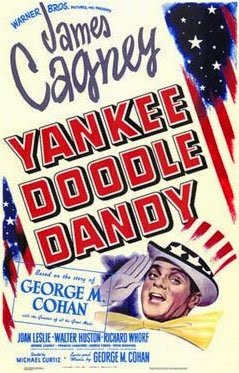
We kick off with an Oscar favourite; a biopic in the form of Yankee Doodle Dandy which focused on the life of composer and showman George M. Cohan. As somebody who wasn't particularly familiar with the name the only thing that drew my eye to the film was the title itself. Indeed, it was later revealed to me that Cohan wrote a number of patriotic songs including 'Over There' which was played to honour the men serving in the First World War. Yankee Doodle Dandy's patriotic nature meant that it had a lot in common with the last 1940s film I watched, Sergeant York. Both were flag-waving endeavours, both starred Joan Leslie as the female lead and both won the award for Best Actor. However I felt that James Cagney's portrayal of Cohan was miles better than Gary Cooper's turn in Sergeant York the previous year. Cagney captivated the screen throughout proving himself to be a fine theatrical presence but also was able to add more pathos to the role when the script required it. The musical numbers that were scattered throughout Yankee Doodle Dandy helped me to understand just why Cohan deserved to have a whole film devoted to him. If I have once criticism of Yankee Doodle Dandy, it's the linear approach that screenwriters Robert Buckner and Edmund Joseph employ. The film sees Cohan narrate his life story to President Roosevelt in a manner that I found quite dry although the musical aspect of the piece more than made up for it. Ultimately I found Yankee Doodle Dandy to be a rather easy watch which was bolstered by a blistering turn from James Cagney.
Nominated alongside Yankee Doodle Dandy in 1943 was Kings Row, a film based on the novel by Henry Bellamann about a number of youngsters growing up in a small town. The film begins with meeting the five characters we'll be spending time with as schoolchildren, which in a way helped to understand their motivations as we saw them grow up in prior years. Among the cast of twentysomethings were Ann Sheridan, Betty Field and a certain whipper-snapper by the name of Ronald Reagan. In fact Reagan's performance as the initially privileged Drake McHugh was possibly the best of the five turns given by the younger cast members. I believe that that has something to do with the fact that McHugh has the most to deal with from losing his inheritance to having his legs lopped off by a sadistic surgeon. As you can tell by that description alone there's a lot of bleak moments in Kings Row including suicide, murder and mental illness. I feel the melodramatic tone of Kings Row was what put me off it especially seeing as the three female members of the cast gave incredibly hammy turns. Erich Wolfgang Korngold's score was similarly overbearing and definitely left little to the imagination. At the same time I can't say that I wasn't moved by anything that happened in Kings Row and I discovered that I'd become invested in at least two of the characters. However, I ultimately believe that Kings Row will be one of the films I've watched throughout this challenge that will soon fade from my memory in the coming weeks.

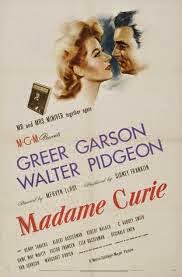
Yankee Doodle Dandy and Kings Row ended up both losing the Best Picture prize to quaint English war yarn Mrs. Miniver which would also see Greer Garson pick up the Lead Actress award. One year later Garson would pair up with her Mrs Miniver co-star Walter Pidgeon for yet another biopic in which would see her portray the brilliant Marie Curie. However the lead characters of Marie and Pierre Curie are the only brilliant things in this really stale and dull biopic. If I didn't know any better I would've thought that Madame Curie had been made in the early 1930s rather than the mid-1940s. There are plenty of things wrong with Madame Curie not least its script which was ridiculously expositional. I wasn't surprised to learn that the script had gone through many rewrites after original scribe Aldous Huxley left the project in 1938. Rather than feeling like a cinematic release, Madame Curie looks like it's been cobbled together as an educational film to inform America's schoolchildren about the discovery of radium. After winning Best Actress the prior year, it appeared as if Greer Garson was exhausted from all the awards ceremonies as she appeared to be simply going through the motions throughout Madame Curie. Walter Pidgeon was slightly better in his role as Pierre; but the pair showed none of the excellent chemistry they shared in Mrs. Miniver and Blossoms in the Dust. One thing you could say in Madame Curie's favour is that it's a thorough retelling of Pierre and Marie's life and work together so if you wanted to know their story this is probably a good starting point. But, apart from being an educational tool, there's very little praise I can heap onto a film which I struggled to watch from beginning to end.

Next time we return to the 21st century and go on a marathon of Best Actor winning pictures.

Wednesday, 30 March 2011

Matt's Big Oscar Challenge Day 108: Go To Hell?

Going into the future films in 1978 there is a film called Heaven Can Wait starring Warren Beatty which is a remake of a nominated film from the 1940s. Confusingly it isn't my next film, Heaven Can Wait, instead it is Here Comes Mr Jordan which I am yet to watch. This version of Heaven Can Wait sees Don Ameche as wealthy Henry Van Cleve a man who has recently passed away and has come to the 'down below', we're assuming it is hell and that Laird Creagar's character simply referred to as 'His Excellency' is Satan. Creagar doesn't believe that Van Cleve should be there so Van Cleve narrates his life story to 'His Excellency'. At first we the audience believe him to be a rogue, or a cad or a bounder from a young age he is corrupted by his young French governess Mademoiselle and given wine. He then steals the fiancée of his boorish cousin and elopes with her before cheating on her towards their tenth anniversary. But then things turn around and Van Cleve becomes both a loving husband and a good father, at one point trying to pay off the woman who is out to ruin his son's reputation. He loses his wife on the eve of their 25th anniversary and although he is swayed briefly by other women he never gives up loving her. It turns out the reason he doesn't think he belongs upstairs is that he doesn't want to run into his wife and other relatives as he thinks he's let them down therefore truly becoming a good person. 'His Excellency' points out that it won't be easy and he may have to stay on the outskirts in a small apartment but one day Van Cleve will be allowed entry.

Heaven Can Wait had a very promising start with Van Cleve's meeting with 'His Excellency' and his subsequent retelling of his adolescence. 'His Excellency's' office is very well designed almost in an avant-garde style and the first scene does promise almost a black comedy. But then after the Van Cleve character starts becoming a good person things start to lag and the whole segment after he loses his wife is very boring indeed. Despite that there are some good performances notably from Charles Coburn as Van Cleve's Grandfather the only person in his family with any sense, Alyn Joslyn as the horrible cousin and Ameche himself. It is also a very clever story a reversal of the pleading with St. Peter to be let into heaven by trying to convince Satan why you belong in hell. But overall I felt a little bit deflated and that the film didn't have enough faith in its darkly comic premise to follow through. Maybe this is the sort of film that could be remade, but then would the title have to be changed to avoid confusion?

Thursday, 12 August 2010

Matt's Big Oscar Challenge Day 81: A Presidential Epic

Following one biopic with another this time about the 28th President of the U.S.A Woodrow Wilson. Ask someone from the UK to name all the presidents of America that they know and they would probably give you Lincoln, Washington, Nixon, Bush, Clinton and Obama and possibly a couple more. But only the more knowledgeable would be able to tell you about Wilson even though he served through two terms and was the President of America during World War 1 and helped forge the League of Nations. The film itself was the project of 20th Century Fox's head honcho Darryl F Zanuck who was a big fan of Wilson's however despite winning five Oscars it was a monumental flop and Zanuck was so disappointed the film was never to be mentioned in his presence again. One of the reasons that the film may not have done so well is that it is incredibly long. I think Zanuck didn't want to leave anything out about Wilson's life but that means that the film does drag from time to time. We see him originally as a Princeton professor who has written many works about politics he is encouraged to run for governor and then eventually for President. Despite not doing much campaigning he is able to get in due to earnest nature. Initially Wilson refuses that America enter the war claiming that he didn't want to be responsible for any American men losing their lives but eventually he decides to help out and even contributes to the war effort. After the war he is one of the leaders involved in the League of Nations who try to ensure that something like a World War doesn't happen again. Some of the leaders disagree but Wilson delivers a speech and eventually they all agree. That seems to be a recurring theme of the film, Wilson's long and worthy speeches which convince people of his ideas. Meanwhile Wilson's personal life is also detailed with the death of his first wife and his very quick romance and marriage to his second wife. This is one of the moments in the film that I found a bit creepy, I thought that Wilson didn't leave it too long before moving on but the film blesses Wilson's new wife because she is the favourite of Wilson's daughters.

The film's best point and possibly reason for its failure is the no-name Alexander Knox as Wilson himself. Knox doesn't look like an actor and doesn't particularly act and that's why the film works I'd go as far to say as his performance is one of the best I've ever seen by a Lead Actor of all time. Showing little emotion from the beginning to the end but still being passionate about his family and his causes, Knox's Wilson is a compelling presence without being overtly loud and over-the-top. There is a large collection of supporting characters the most famous of whom are Charles Coburn and oddly Vincent Price as one of Wilson's political aides. Supposedly the film glossed over some of Wilson's flaws his very belligerent nature as well as his inherent racism aren't mentioned at all. The film also is very pro-America propaganda, as the film was released while the war was still on and it is very support our troops and boo the Germans. Despite though this is a fairly enjoyable if overlong biopic with a stunning central performance.

Friday, 30 July 2010

Matt's Big Oscar Challenge Day 69: Three's Company

As we saw in the 1930s there were a lot of Screwball comedies knocking about, these films usually revolved around a couple who weren't together for some reason and had to resolve issues - usually of class in order to become a couple by the end. That tradition seems to continue in The More the Merrier, a nominee at the 1944 ceremony which was a film that touched on the serious issue of the housing shortage during the Second World War but did it with plenty of screwball comedy-esque touches. The film revolves around Benjamin Dingle, an adviser on the housing shortage who arrives in Washington to find his hotel won't be ready for two days. Dingle then has to find an apartment and ends up moving in with a young girl named Constance Milligan. Constance and Dingle have trouble working out a routine while living together which is further complicated when Dingle rents half of his room out to soldier Joe Carter. Joe and Constance start to fall for each other but she is already engaged to the straight-laced bureaucrat Charles Pendergrass. Through several different means Dingle starts to orchestrate situations where Joe and Constance will be together and even delays Pendergrass by asking him to help with some of his duties. From there, there are romantic complications as Joe and Constance fall in love and Pendergrass then discovers the whole house-sharing mess. The final scene sees Dingle seal the fate of the two younger characters and then sings outside their door with a group of homeless men.

I really enjoyed The More The Merrier and I even found myself laughing out loud at some points, something I have rarely done to any of these films. Most of the reason for that is down to Charles Coburn as Dingle, who steals every scene he is in and the highlight is the very first morning he and Constance are together they construct an almost silent routine which is absolutely hilarious. Coburn won the Oscar for Supporting Actor that year, the only award the film received, and that was more than justified just as with Lionel Barrymore in the 1930s, Coburn is a supporting star who we will see more of throughout the decade. Jean Arthur, previously the plucky heroine in You Can't Take it With You, here plays the practical but ultimately romantic Constance with some ease and also earned an Oscar nomination. The film does suffer when Coburn isn't on the screen and the romantic scenes between Joe and Constance go on a little too long. However the film is incredibly well written and also well shot including the scenes in which Joe and Constance talk to each other through the wall which are filmed through the window so you can see both characters. A nice little comedy with a serious social issue at its heart and some good performances.