Showing posts with label Greer Garson. Show all posts

Sunday, 25 January 2015

Matt's Big Oscar Challenge Days 372-374: Days of Future Past Part Four

We rewind once again and this time embark on a journey through three films that were nominated for Best Picture during the 1940s.

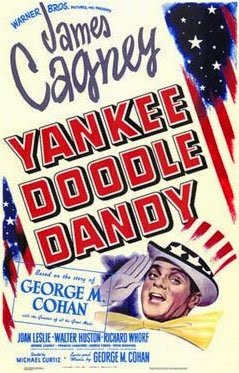
We kick off with an Oscar favourite; a biopic in the form of Yankee Doodle Dandy which focused on the life of composer and showman George M. Cohan. As somebody who wasn't particularly familiar with the name the only thing that drew my eye to the film was the title itself. Indeed, it was later revealed to me that Cohan wrote a number of patriotic songs including 'Over There' which was played to honour the men serving in the First World War. Yankee Doodle Dandy's patriotic nature meant that it had a lot in common with the last 1940s film I watched, Sergeant York. Both were flag-waving endeavours, both starred Joan Leslie as the female lead and both won the award for Best Actor. However I felt that James Cagney's portrayal of Cohan was miles better than Gary Cooper's turn in Sergeant York the previous year. Cagney captivated the screen throughout proving himself to be a fine theatrical presence but also was able to add more pathos to the role when the script required it. The musical numbers that were scattered throughout Yankee Doodle Dandy helped me to understand just why Cohan deserved to have a whole film devoted to him. If I have once criticism of Yankee Doodle Dandy, it's the linear approach that screenwriters Robert Buckner and Edmund Joseph employ. The film sees Cohan narrate his life story to President Roosevelt in a manner that I found quite dry although the musical aspect of the piece more than made up for it. Ultimately I found Yankee Doodle Dandy to be a rather easy watch which was bolstered by a blistering turn from James Cagney.
Nominated alongside Yankee Doodle Dandy in 1943 was Kings Row, a film based on the novel by Henry Bellamann about a number of youngsters growing up in a small town. The film begins with meeting the five characters we'll be spending time with as schoolchildren, which in a way helped to understand their motivations as we saw them grow up in prior years. Among the cast of twentysomethings were Ann Sheridan, Betty Field and a certain whipper-snapper by the name of Ronald Reagan. In fact Reagan's performance as the initially privileged Drake McHugh was possibly the best of the five turns given by the younger cast members. I believe that that has something to do with the fact that McHugh has the most to deal with from losing his inheritance to having his legs lopped off by a sadistic surgeon. As you can tell by that description alone there's a lot of bleak moments in Kings Row including suicide, murder and mental illness. I feel the melodramatic tone of Kings Row was what put me off it especially seeing as the three female members of the cast gave incredibly hammy turns. Erich Wolfgang Korngold's score was similarly overbearing and definitely left little to the imagination. At the same time I can't say that I wasn't moved by anything that happened in Kings Row and I discovered that I'd become invested in at least two of the characters. However, I ultimately believe that Kings Row will be one of the films I've watched throughout this challenge that will soon fade from my memory in the coming weeks.

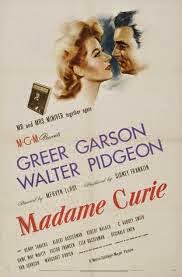
Yankee Doodle Dandy and Kings Row ended up both losing the Best Picture prize to quaint English war yarn Mrs. Miniver which would also see Greer Garson pick up the Lead Actress award. One year later Garson would pair up with her Mrs Miniver co-star Walter Pidgeon for yet another biopic in which would see her portray the brilliant Marie Curie. However the lead characters of Marie and Pierre Curie are the only brilliant things in this really stale and dull biopic. If I didn't know any better I would've thought that Madame Curie had been made in the early 1930s rather than the mid-1940s. There are plenty of things wrong with Madame Curie not least its script which was ridiculously expositional. I wasn't surprised to learn that the script had gone through many rewrites after original scribe Aldous Huxley left the project in 1938. Rather than feeling like a cinematic release, Madame Curie looks like it's been cobbled together as an educational film to inform America's schoolchildren about the discovery of radium. After winning Best Actress the prior year, it appeared as if Greer Garson was exhausted from all the awards ceremonies as she appeared to be simply going through the motions throughout Madame Curie. Walter Pidgeon was slightly better in his role as Pierre; but the pair showed none of the excellent chemistry they shared in Mrs. Miniver and Blossoms in the Dust. One thing you could say in Madame Curie's favour is that it's a thorough retelling of Pierre and Marie's life and work together so if you wanted to know their story this is probably a good starting point. But, apart from being an educational tool, there's very little praise I can heap onto a film which I struggled to watch from beginning to end.

Next time we return to the 21st century and go on a marathon of Best Actor winning pictures.

Thursday, 2 June 2011

Matt's Big Oscar Challenge Day 135-136: Mostly Marlon

So after my Elizabeth Taylor retrospective we have four films from Marlon Brando an actor who was considered to have changed the way actors were perceived on films. Once upon a time you had the classic 'film star' such as Fred Astaire, Mickey Rooney or Cary Grant but then Brando was a new breed of actor who really got into the character and developed the phrase method acting. Here is part one of two blogs looking at the four Brando films nominated for the Best Picture prize.


We finished the last instalment of the Oscar blog with a Tennessee Williams adaptation and we start our Marlon Brando retrospective with another Williams story - A Streetcar Named Desire. For those of you unaware with the story it sees the demure but emotionally fragile Blanche Dubouis journey to New Orleans to stay with her sister Stella and Stella's husband the brutish Stanley played by Brando. As time goes on Brando continues to resent Blanche's domination of Stella's time and her relationship with his friend Mitch so he starts to dig dirt on why she had to leave her old home. The final confrontation with ends in Stanley raping Blanche before she is carted off to a mental institution is very well done by director Elia Kazan by taking the camera around the expressions of all the characters and using the strong score to play the emotions of the two sisters with Stella finally seeing the light and leaving her husband with their new baby. As someone who read the play as part of my English literature A-Level I have to say that everybody involved did their best to recreate what this story should be. The set direction was rightfully given an Oscar for providing the claustrophobic atmosphere of both Stanley and Stella's apartment to the small area in which the characters inhabit. Vivien Leigh had previously played Blanche on the stage in London and bought both star power and incredible timing as a character who slowly loses her mind throughout the film. Kim Hunter is great as the tortured Stella while Karl Malden also stole the show in his couple of scenes as the hapless Mitch who wants to tame Blanche but realises that is impossible. Leigh, Malden and Hunter all won Oscars for their performances indeed the only person who didn't win an acting Oscar was Marlon Brando. However Brando won something else a new found fame for his great turn as Stanley he plays a man who was raised to behave a certain way and is almost tortured every time he hurts Stella and she leaves him briefly. He is brutish but at the same time doesn't go over-the-top and most importantly he becomes the character this isn't Marlon Brando as Stanley this is Stanley and you can really believe it. One more thing about the film is Alex North's great score who went against type composing short pieces of music to reflect the trauma of the characters but unfortunately he didn't win the Oscar but he did set a precedent in terms of film music as maybe Brando did with character development.

After his Oscar nomination for Streetcar, Brando was nominated for Viva Zapata at the next Oscar ceremony and then again at the Oscar ceremony held in 1954. However nobody quite expected that role to be in an adaptation of William Shakespeare's Julius Caesar. The film saw a lot of Shakespeare pros take the parts that they'd already taken on stage for example British theatrical legend John Gielgud played Cassius and James Mason who also had Shakespearian experience was Brutus here. Even producer John Houseman had Caesar experience having been involved in the classic Orson Welles Mercury Theatre production but by this time Welles and Houseman had fallen out and Welles wanted nothing to do with this production. However Brando's casting as Marc Anthony was met with scepticism to the point of Paul Scofield being on standby if Brando's screen test bombed however Brando was so good that Gielgud offered him the lead in the production of Hamlet he was directing, Brando turned this offer down. I'm really not going to retype the plot of Caesar as we all know the first half sees many of his followers conspire his demise and the second half sees Anthony's rise. While we're on Anthony Brando was brilliant even though he had very little to do in the first half of the film from the 'Friends, Romans, Countrymen' speech onwards he captures the imagination being able to deliver Shakespeare's lines with all the precision of a pro and the doubts that the 'mumbler' wouldn't be able to perform were cast aside here. I'm not sure if it was good enough to be Oscar nominated but maybe the Academy were so surprised by Brando's performance that he got the nod just for doing something different. Aside from Brando the ensemble cast are all terrific especially Mason's Brutus and Louis Calhern's Caesar. I also have to applaud the set design for giving us something grandiose and recreating ancient Rome brilliantly and also for handling the crowd scenes very well.

Thursday, 14 April 2011

Matt's Big Oscar Challenge Day 116: Keeping the British End Up


As we spirit towards the finish line of the 1940s its time for the last winner of that decade in William Wyler's Mrs Miniver. The film, like Blossoms in the Dust, stars Greer Garson and Walter Pidgeon as a happily married couple and parents to three children, two youngsters and a very upper-class lad called Vin who is off at university when the film begins. In fact Mrs Miniver is mostly about how normal families and indeed normal towns are affected by the war. So for example Vin leaves university to join the RAF meanwhile he also gets married to Carol the granddaughter of the snooty Lady Beldon. Mrs Miniver's husband Clem also agrees to volunteer the best way he can and helps in the Dunkirk evacuation. One of the most shocking parts of the film is where Mrs Miniver finds a German soldier in her house and is held at gunpoint until she provides him with food she then calmly phones the police and he is arrested. There is also a subplot involving a rose grown by the train station controller and named after Mrs Miniver which is entered in the flower show against Lady Beldon, who usually wins it. Beldon announces the winner and sees her name on the card but instead gives it to the station master and the Mrs Miniver rose as again war has changed her. The film though does have a tragic conclusion featuring the death of one of the major characters and a solemn message of the dangers and casualties of war.

For me Mrs Miniver is an odd beast and it doesn't feel like a winner in the way Gone with The Wind, Casablanca or even The Best Years of Our Lives did. One reason for that might be its awfully quaint and middle-class, the village that the Minivers inhabit is one in which everybody knows everybody else and its all lovely and cosy until those awful Nazis come along and ruin everything. I suppose one reason this may have won is because there was very little competition this year and also because it may've been the most accurate depiction of wartime yet. As well as Best Picture and Best Director for Wyler both Garson and Teresa Wright as Carol both won Oscars, again this wasn't my favourite Garson performance that was in Random Harvest but Wright is very good as the young girl married too soon and then having to contend with her new husband off fighting the war. Dame Mae Witty as Lady Beldon, Pidgeon as Clem and Henry Travers as Vin were also nominated and I like the fact that Travers actually later married his on screen mother Garson. There's nothing particularly wrong with Mrs Miniver it's a nice enough film but it just doesn't have anything about it to make a significant impact and make me believe that it should've won Best Picture.

Monday, 4 April 2011

Matt's Big Oscar Challenge Day 111: Doing it For the Kids

There are some films on this list that I read the plot of and I instantly want to watch others I have to force myself and Blossoms in the Dust does definitely fall into the latter category. The film is based around the true story of Greer Garson's Edna and how she overcomes tragedy after tragedy to set up a successful home for orphans until they are rehoused into loving families. The story starts with Edna due to be married to the boorish Damon only for Walter Pidgeon's bank clerk Sam to whisk her off her feet. Meanwhile Edna's adopted sister Charlotte is due to marry her fiancée Allen but is stopped when it turns out that Charlotte was adopted by Edna's parents. Unable to marry the man of her dreams Charlotte commits suicide but that's not the end of Edna's worries. She barely survives giving birth to her daughter only for that daughter to wind up dying about five years later on. After finding out she can no longer have children Edna and Walter set up a home for rehousing orphans which is shut down after Edna upsets one of the more important ladies of the town and the couple up roots and move. Soon Walter takes ill and dies leaving Edna to fight her own battles including one with a lowlife man who wants to get some money from the wealthy couple who adopted his son and Edna also battles to remove the stigma from those children who get adopted so they can live a normal life and not end up like Charlotte. The film ends with Edna successful in her quest but still feeling lonely in life unable to form attachments to any of the children as she knows she won't be around all their lives. Her only constant throughout the film is Max, a doctor who befriends the couple and who is Edna's confidant after Sam dies.

There's really only so much one woman can go through and blimey did Edna go through it all - the death of her friend, her child and her husband not to mention not being able to have children again and being chased out of town. This was one hell of a woman and its nice for her to be recognised but at the same time I feel like the film was just too overly melodramatic for my liking. I do like Greer Garson as an actress, especially in Random Harvest a film she was not Oscar nominated for, but here she fights an uphill battle portraying a character who demands sympathy in every scene and can't seem to catch a break. Walter Pidgeon is fine as the charming caddish Sam but once he starts to get ill he also turns into a bit of wimp and starts talking in wistful terms. In fact my favourite characters in the film were Max the doctor and Zeke the couple's loveable servant who follows them all over the country. Unfortunately if this were released today I still reckon it would get its Oscar nomination because it's one of those dreary heartfelt dramas that Oscar love to acknowledge.

Wednesday, 12 January 2011

Matt's Big Oscar Challenge Day 97-98: Catch-up Part 6


Back to the 1940 ceremony which did have one of the strongest fields with Gone With the Wind beating films like The Wizard of Oz, Mr Smith Goes to Washington and Goodbye Mr Chips. The latter film features Robert Donat as inspirational teacher Mr. Chipping affectionally known as Mr Chips. The story takes place over 63 years from Chips coming to the all boys' school Brookfield Public School and sees Robert Donat giving a great Oscar winning performance as the man himself. During his time at the school, Chips faces resistance from the staff and governors, falls in love and tragically loses his wife in childbirth. The film looks at themes of authority, belonging and lost love and is very well made indeed.

Like Johnny Belinda, 1944 nominee For Whom The Bell Tolls was nominated for all four acting awards and did actually triumph in the Supporting Actress category. The film is an adaptation of Hemmingway's classic tale of a bridge being blown up during the war and stars Gary Cooper and Ingrid Bergman in the lead roles. But the two supporting performances from Akim Tamiroff as the treacherous Pablo and Katrina Paxinou as the motherly Pilar. While I film the film a bit long and laborious I thought Cooper was magnficent and also the scenes featuring the explosions were well made considering when the film was produced.

Sunday, 15 August 2010

Matt's Big Oscar Challenge Day 84: Lost Memories


Getting towards watching my 100th film on the list, its started me reflecting on why I started this journey in the first place. I think it was mainly to watch some films that I'd never got round to but it has become discovering others that I'd never been aware of but I really enjoyed after watching. The 1943 nominee Random Harvest falls into this latter category it deals with Ronald Colman's character a man who loses his memory several times throughout the film. Colman is initially in a mental institution when the film begins as he has lost his memory after becoming shell-shocked in the trenches. He escapes from the institution after he sneaks past the guards who are celebrating the end of World War I. He is helped out by a showgirl named Paula who helps conceal his identity and eventually the two begin and romance and then marry. As Colman went by the name John Smith, Paula starts to call him Smithy and he discovers he has a talent for writing and journeys to Liverpool to see about getting a job as a writer leaving a pregnant Paula behind. While in Liverpool he is hit by a cab, although he is physically fine he loses his memory of his time with Paula and reverts back to his original identity of Charles Rainer heir to a large business dynasty. Rainer returns to his family home of Random House the day after his father's death and it turns out that he is to inherit the house. Charles hopes to return to college but ends up taking over the family business and making it successful leading to a newspaper article calling himself the 'industrial prince of England'. Charles then gets a new secretary Margaret, Paula who is now using her real name, Margaret wants to reveal all to Charles but her friend tells her that it would just startle him so she has him declared legally dead and their marriage annulled. Charles then starts to romance Kitty, the step-daughter of one of his brothers, who has been smitten with him since she was fifteen. Charles and Kitty plan to get married however while planning the wedding Charles' memory is stirred by one of the hymns that Kitty has chosen which reminds him of his time with Paula. He then realises he is in love with someone else that he can't remember and calls off the engagement to Kitty. Later Charles stands for Parliament and succeeds thanks to Margaret's support, realising that he needs a wife he proposes to her as more of a business arrangement and she accepts. However she becomes unhappy that Charles will never remember her and decides to go on an extended holiday to South America. At the same time Charles has to go to the place he and Margaret once lived in order to deal with some unrest at a factory he owns there. While there his memory finally starts to come back to him and he returns to their old house where he finds Margaret, who is visiting the place before taking off on the cruise liner, she calls out to him as Smithy and he embraces her finally remembering their connection.

Although I'm not usually one for romantic films I thought the way that all of Random Harvest was laid out was superb. From the opening shots of the imposing gates of the Mental Institution to the grandiose splendour of Random House to the small house that 'Paula' and 'Smithy' shared every set is given the same amount of care. The two leads also make you care immensely about their characters. Although Ronald Colman has always impressed me this seems to be his best role thus far in the list, his character changes from amnesiac patient to carefree writer to prince of industry and then to a government lord and Colman is able to show all these transitions with ease. As the film's female lead Greer Garson is also able to portray a woman who has lost the two things that are most important to her, Smithy and her child who died in infancy. There is also a fine performance by Susan Peters as the spirited and ultimately heartbroken Kitty who also grows as a character as the film progresses. The film was nominated for seven Oscars but was completely unsuccessful with Garson not even nominated for this film, however she was nominated for another performance that year, Colman and Peters did receive nods but failed to win. Overall this was a thoroughly well-made and well-acted film that engaged me from beginning to end.