Showing posts with label Teresa Wright. Show all posts
Showing posts with label Teresa Wright. Show all posts
Thursday, 14 April 2011
Matt's Big Oscar Challenge Day 116: Keeping the British End Up
As we spirit towards the finish line of the 1940s its time for the last winner of that decade in William Wyler's Mrs Miniver. The film, like Blossoms in the Dust, stars Greer Garson and Walter Pidgeon as a happily married couple and parents to three children, two youngsters and a very upper-class lad called Vin who is off at university when the film begins. In fact Mrs Miniver is mostly about how normal families and indeed normal towns are affected by the war. So for example Vin leaves university to join the RAF meanwhile he also gets married to Carol the granddaughter of the snooty Lady Beldon. Mrs Miniver's husband Clem also agrees to volunteer the best way he can and helps in the Dunkirk evacuation. One of the most shocking parts of the film is where Mrs Miniver finds a German soldier in her house and is held at gunpoint until she provides him with food she then calmly phones the police and he is arrested. There is also a subplot involving a rose grown by the train station controller and named after Mrs Miniver which is entered in the flower show against Lady Beldon, who usually wins it. Beldon announces the winner and sees her name on the card but instead gives it to the station master and the Mrs Miniver rose as again war has changed her. The film though does have a tragic conclusion featuring the death of one of the major characters and a solemn message of the dangers and casualties of war.
For me Mrs Miniver is an odd beast and it doesn't feel like a winner in the way Gone with The Wind, Casablanca or even The Best Years of Our Lives did. One reason for that might be its awfully quaint and middle-class, the village that the Minivers inhabit is one in which everybody knows everybody else and its all lovely and cosy until those awful Nazis come along and ruin everything. I suppose one reason this may have won is because there was very little competition this year and also because it may've been the most accurate depiction of wartime yet. As well as Best Picture and Best Director for Wyler both Garson and Teresa Wright as Carol both won Oscars, again this wasn't my favourite Garson performance that was in Random Harvest but Wright is very good as the young girl married too soon and then having to contend with her new husband off fighting the war. Dame Mae Witty as Lady Beldon, Pidgeon as Clem and Henry Travers as Vin were also nominated and I like the fact that Travers actually later married his on screen mother Garson. There's nothing particularly wrong with Mrs Miniver it's a nice enough film but it just doesn't have anything about it to make a significant impact and make me believe that it should've won Best Picture.

Wednesday, 11 August 2010
Matt's Big Oscar Challenge Day 80: Take Me Up to the Ball Park
Those who know me know that I know very little about sports and of that
little knowledge hardly any of it is given up to the sport of baseball.
However I am familiar with the name Babe Ruth who actually features as
himself in the next film about another New York Yankee player Lou
Gerhig. Gerhig died tragically aged only 37 and this film was made and
released the year after his death. Gary C ooper
was cast in the role of Gerhig which is an odd choice seeing as Lou is
in his 20s for the majority of the film and Cooper was in his 40s by
this stage of his career. Despite this Cooper is still a decent actor
and does his best to show Gerhig from being scouted by The Yankees to
becoming the most reliable player on the team. The film also
concentrates on three of the most important relationships in his life.
Firstly that between Gerhig and his parents, his understanding and
down-to-Earth father and his interfering mother. The relationship with
his mother is one of the film's most interesting as she argues with
everyone that Lou should be an engineer and not a baseball player even
though he has an obvious talent for him. The second relationship is
between Lou and the sportswriter Sam Blake played by Walter Brennan.
Blake is the man who sees potential in Gerhig and persuades the Yankees
to give him a try out, Blake later becomes Gerhig's confident and always
stands up for him. And finally there is Gerhig's romance with Eleanor
Twtichell who he first meets when she watches one of his games. Their
relationship is basically without turmoil apart from some interfering
from his mother. They get married and although she does get a little
tired of being a baseball star's wife she doesn't stop loving Lou.
Although tragically the final third of the film looks at Lou becoming
ill and gets a fatal motor neuron disease which would later go on to
become known as Lou Gerhig's disease. Lou keeps on playing as long as he
can but one day he realises that he has to be pulled from the team and
makes a last minute decision not to play. The film ends with Gerhig's
goodbye speech to the fans which must've been a fairly poignant moment
to the original film audience as Gerhig had just died.
The film itself is only okay, it is a very traditional biopic however most of Gerhig's life is really without incident. A lot of the scenes depict life on the road with the baseball team, most of them playing themselves, Babe Ruth in particular sends himself up as a big-headed moron who the rest of the team play pranks on. The acting isn't too bad either, Walter Brennan is possibly the cast's MVP as Sam Blake he just plays an ordinary decent bloke. Despite being too old for the part Cooper still gives it his all and manages to give a sympathetic performance and both he and Teresa Wright, as his wife, were nominated for Oscars. But by today's standards the film is incredibly cheesy, there is an extended segment in which Gerhig promises to hit a home run for a kid in hospital which he obviously does and later in the film the kid who has now grown up comes to see Lou say his farewell. The film was nominated for a total of eleven statues but only managed to win one award, which was bizarrely for editing but it lost out to Mrs Miniver in the Best Picture category. I think this one would probably work if I understood and cared about baseball a bit more but sadly that's never gonna happen.
 ooper
was cast in the role of Gerhig which is an odd choice seeing as Lou is
in his 20s for the majority of the film and Cooper was in his 40s by
this stage of his career. Despite this Cooper is still a decent actor
and does his best to show Gerhig from being scouted by The Yankees to
becoming the most reliable player on the team. The film also
concentrates on three of the most important relationships in his life.
Firstly that between Gerhig and his parents, his understanding and
down-to-Earth father and his interfering mother. The relationship with
his mother is one of the film's most interesting as she argues with
everyone that Lou should be an engineer and not a baseball player even
though he has an obvious talent for him. The second relationship is
between Lou and the sportswriter Sam Blake played by Walter Brennan.
Blake is the man who sees potential in Gerhig and persuades the Yankees
to give him a try out, Blake later becomes Gerhig's confident and always
stands up for him. And finally there is Gerhig's romance with Eleanor
Twtichell who he first meets when she watches one of his games. Their
relationship is basically without turmoil apart from some interfering
from his mother. They get married and although she does get a little
tired of being a baseball star's wife she doesn't stop loving Lou.
Although tragically the final third of the film looks at Lou becoming
ill and gets a fatal motor neuron disease which would later go on to
become known as Lou Gerhig's disease. Lou keeps on playing as long as he
can but one day he realises that he has to be pulled from the team and
makes a last minute decision not to play. The film ends with Gerhig's
goodbye speech to the fans which must've been a fairly poignant moment
to the original film audience as Gerhig had just died.
The film itself is only okay, it is a very traditional biopic however most of Gerhig's life is really without incident. A lot of the scenes depict life on the road with the baseball team, most of them playing themselves, Babe Ruth in particular sends himself up as a big-headed moron who the rest of the team play pranks on. The acting isn't too bad either, Walter Brennan is possibly the cast's MVP as Sam Blake he just plays an ordinary decent bloke. Despite being too old for the part Cooper still gives it his all and manages to give a sympathetic performance and both he and Teresa Wright, as his wife, were nominated for Oscars. But by today's standards the film is incredibly cheesy, there is an extended segment in which Gerhig promises to hit a home run for a kid in hospital which he obviously does and later in the film the kid who has now grown up comes to see Lou say his farewell. The film was nominated for a total of eleven statues but only managed to win one award, which was bizarrely for editing but it lost out to Mrs Miniver in the Best Picture category. I think this one would probably work if I understood and cared about baseball a bit more but sadly that's never gonna happen.
Saturday, 7 August 2010
Matt's Big Oscar Challenge Day 76: Bad Bad Bette
Returning to the 1942 ceremony here with the third and final
collaboration between Bette Davis and director William Wyler. Wyler and
Davis worked on Jezebel and The Letter, which I will watch eventually
but The Little Foxes would see their relationship crumble. The film
itself concerns the Hubbard family brothers Oscar and Ben and sister
Regina, played by Davis. Regina has married the wealthy Horace because,
as a woman, she isn't considered equal to her brothers. Meanwhile Oscar
has married the dippy Birdie who is extremely kind but Oscar has 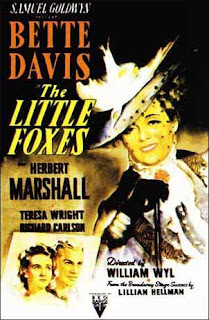 broken
her spirit and she drinks regularly. Oscar married Birdie for her
family's land and he and Ben now plan to build a cotton mill on that
land. However they are short and come to Regina for the rest of the
money, she says she will get it from Horace but she wants a larger share
than her brothers if she does. Horace refuses to give his wife the
money so the brothers concoct a plan to steal Horace's bonds from the
bank enlisting Oscar's simpleton son who works there. When Horace finds
out he doesn't tell the police instead letting the brothers take the
bonds which enrages Regina who wants to use the theft to bribe her
brothers. Just then the sickly Horace has a heart attack and Regina
leaves him instead of getting his pills. He dies and she manages to
bribe her brothers and get her larger share in the business but in the
process loses her daughter Alexandra who is upset about her father's
death and absconds with her suitor David.
I would say The Little Foxes is a film you could definitely define as a 'women's film'. The male characters are either greedy (Oscar and Ben), thick (Leo) or kind but sick (Horace). In fact the character of David had to be created to add another sympathetic male to the story but even David isn't perfect and can't hold his tongue over his hatred of the Hubbard family. The three female leads all received Oscar nods again Davis plays a monstrous woman who is battling for equal rights for women but going about it the entirely wrong way. Teresa Wright's Alexandra is the film's moral compass, as Alexandra she is grown out of a childlike admiration for her mother and realises that her family isn't as perfect as she once though. While Patricia Collinge as Birdie gives a multi-layered performance of a very sweet women who is on the verge of a nervous breakdown thanks to her husband Oscar's constant berating of her. In her final scene she has a mini-breakdown and it is one of the film's best and most hear-tbreaking scenes. The sets are brilliant with Regina and Horace's house particularly lavish however this is where Davis and Wyler fell out as she didn't think that a family who had money problems would afford a place like this. Davis did eventually quit the picture but when Wyler threatened to sue her for the cost of the film she came back and finished but didn't do a slapdash job at all. The film got eight nominations but won none of them and this was another film that lost out to the inferior How Green Was My Valley. A very good melodrama it's a shame that Wyler and Davis never worked together again because this film is expertly made and brilliantly played.
 broken
her spirit and she drinks regularly. Oscar married Birdie for her
family's land and he and Ben now plan to build a cotton mill on that
land. However they are short and come to Regina for the rest of the
money, she says she will get it from Horace but she wants a larger share
than her brothers if she does. Horace refuses to give his wife the
money so the brothers concoct a plan to steal Horace's bonds from the
bank enlisting Oscar's simpleton son who works there. When Horace finds
out he doesn't tell the police instead letting the brothers take the
bonds which enrages Regina who wants to use the theft to bribe her
brothers. Just then the sickly Horace has a heart attack and Regina
leaves him instead of getting his pills. He dies and she manages to
bribe her brothers and get her larger share in the business but in the
process loses her daughter Alexandra who is upset about her father's
death and absconds with her suitor David.
I would say The Little Foxes is a film you could definitely define as a 'women's film'. The male characters are either greedy (Oscar and Ben), thick (Leo) or kind but sick (Horace). In fact the character of David had to be created to add another sympathetic male to the story but even David isn't perfect and can't hold his tongue over his hatred of the Hubbard family. The three female leads all received Oscar nods again Davis plays a monstrous woman who is battling for equal rights for women but going about it the entirely wrong way. Teresa Wright's Alexandra is the film's moral compass, as Alexandra she is grown out of a childlike admiration for her mother and realises that her family isn't as perfect as she once though. While Patricia Collinge as Birdie gives a multi-layered performance of a very sweet women who is on the verge of a nervous breakdown thanks to her husband Oscar's constant berating of her. In her final scene she has a mini-breakdown and it is one of the film's best and most hear-tbreaking scenes. The sets are brilliant with Regina and Horace's house particularly lavish however this is where Davis and Wyler fell out as she didn't think that a family who had money problems would afford a place like this. Davis did eventually quit the picture but when Wyler threatened to sue her for the cost of the film she came back and finished but didn't do a slapdash job at all. The film got eight nominations but won none of them and this was another film that lost out to the inferior How Green Was My Valley. A very good melodrama it's a shame that Wyler and Davis never worked together again because this film is expertly made and brilliantly played.
Friday, 6 August 2010
Matt's Big Oscar Challenge Day 75: Post War Blues
Even though all these films are over sixty years old some of them still resonate and are relevant in today's environment. That's especially true of the winner at the 1947 ceremony, The Best Years of Our Lives, which does in fact share some similarities with the final scenes of this year's winner The Hurt Locker. The film follows the post-war lives of three men who meet on a plane flying back to the small town in which they all live. They are Sergeant Al Stephenson played by Frederic March, Captain Fred Derry portrayed by Dana Andrews and navy man Homer who lost both arms during the war and now has hooks as replacements. Fred returns to find that Mary the girl he married just before the war has moved into an apartment of her own and is now working in a nightclub. Fred struggles to find work eventually returning to the drugstore where he was once employed he earns a pittance and finds himself working under the man who was his assistant before the war. The only joy he finds is in meeting Al's daughter Peggy who helps him when he has nightmares, he falls for her but thinks he has a duty to Marie. After getting fired from the drugstore and finding out about Marie's other man he moves away and ends up helping at a building scheme to turn old scrapped airplanes into new buildings. Meanwhile Al has developed a bit of a drinking problem but is helped through it by his long suffering wife Milly, played by Myrna Loy, as well as his two children. Al is promoted at the bank where he works because of his military service but later gives a loan to a former soldier who has no collateral and is criticised by his boss. Homer's story is possibly the most interesting although he has lost both of his hands he still wants to be as independent as possible. His family and his 'girl' Wilma both try and act like they're find with what has happened but are both secretly upset. One of the film's most heart-breaking scenes is where Homer shows Wilma how helpless he is without his hands and that he always needs someone to help him before he goes to bed. This is meant to warn Wilma off but she decides to stick with Homer and the final scene is their wedding where Al and Millie are guests and Fred is the best man. The final shot is of Peggy and Fred's eyes meeting across the room and finally embracing as the film ends.
The film's title The Best Years of Our Lives refers to a line in the film spoken by Marie in which she tells Fred that she gave up the best years of her life for him. But I think generally it refers to the time that three men spent in the war, that was the best years of their lives and now they are struggling to get their lives back on track. I mentioned The Hurt Locker because it resonated with the final scenes in which the Jeremy Renner character decided that he couldn't live his mundane life and decided to return to action. And indeed the men here find their lives mundane and things have changed a lot. The performances are faultless with two of the three leads winning Oscars for their roles. Frederic March won the Lead Actor Oscar however I would argue that Dana Andrews possibly deserved it more because Fred's journey is a lot bigger than Al's and Andrews gives a stunning portrayal of a man who just isn't coping. Harold Russell, as Homer, won Best Supporting Actor and also a Special Award for bringing hope and comfort for veterans who had been injured in the war. In fact Russell wasn't a professional actor and was spotted in a documentary about wounded serviceman by director William Wyler. Having found that out after watching the movie I'm surprised as Russell's performance was absolutely captivating, and he is only one of two non-actors to win an acting Oscar, the other being Haing S Ngor for The Killing Fields.
After the last two Oscar winning films I watched turning out to be fairly ordinary or overly theatrical its nice to watch a film that truly deserved all of the accolades that were given to it. A truly amazing piece of work that I would recommend to anyone.
Subscribe to:
Posts (Atom)