Showing posts with label Bette Davis. Show all posts
Showing posts with label Bette Davis. Show all posts
Tuesday, 28 February 2012
Matt's Big Oscar Challenge Day 151: All About Bette
So I'm in catch-up mode with three films that I watched last year but haven't yet reviewed so will start off with the absolute classic that has stayed with me long after I finished watching it.
I'm talking of course of All About Eve a glorious film and a classic which I ashamedly
hadn't watched previously. It did win the Best Picture award in 1951 but
shockingly only one acting award for George Sanders' memorable
performance as the bitchy journalist. The film starts with Bette Davis'
Margo Channing and Celeste Holm's Karen Richards both reminiscing about
the first time they met Anne Baxter's Eve Harrington as she wins an
award for her acting. Karen, the wife of a scriptwriter, introduces Eve
to star actress Margo who eventually hires her as an assistant despite
suspicions from her current helper Birdie played with vigour by the
brilliant Thelma Ritter. As the film goes on Eve plants herself into
Margo's life more with the actress now becoming paranoid it seems that
Eve has now become Margo's understudy later garnering rave reviews after
intentionally making Margo late for a performance. Eve then starts
flirting with Sanders' Addison who thinks he's figured out but then she
starts lying to him about an affair she is having with Karen's wife
Lloyd. Addison finally unravels Eve's backstory and then the whole thing
finally comes full circle when a girl like Eve comes to her doorstep
claiming admiration for her. Everything is right about All About Eve
which is evident from its fourteen nominations and only six wins. It's
always obvious to wax lyrical about Baxter or Davis but for me it's
Celeste Holm who holds everything together by not playing a person who
is part of the showbiz set and who is genuinely taken with the young
innocent Eve. This is a film that demonstrates the perils of fame and
what some people will do to get ahead but is presented in a way that
never alienates the audience by in the end letting the characters get
their just deserts. Overall a brilliant film that deserves all the
accolades it picked up at the 1951 ceremony.

Wednesday, 11 May 2011
Matt's Big Oscar Challenge Day 126: The Bette Quartet Part Four
So we've finally made it, it's the last film in the 1940s section of the Big Oscar Challenge and it ties in nicely with the end of the Bette Davis quartet however in Watch on the Rhine she is less of the star and more part of an ensemble including an Oscar winning turn from Paul Lukas as her German husband. The film, based on a successful Broadway play, sees Lukas and Davis' Kurt and Sara journey from Germany to Washington to stay with Sara's mother and brother. Kurt is a staunch anti-Nazi and had been involved in resistance work in both Germany and Spain and he, Sara and their three children had hoped to lie low but because of Sara's mother Fanny's other houseguests that wasn't the case. Also staying with Fanny were the Romanian count Tec and his young wife Marthe who is secretly in love with David. Tec consorts with Nazi Officers and plays poker with them and threatens to reveal Kurt's whereabouts and his desire to return to Germany unless he is given money. Instead of paying off Tec, David shoots him and then flees to Germany after not hearing from his for five months, Sara's eldest Son Joshua reveals his plans to return to their homeland and find his father and asks his mother to prepare his younger brother for the time where he may be called to do the same thing.
As always seems to be the case Bette Davis was at war with most of the people involved in the film from the very beginning. She didn't like the fact that Herman Shumlin, who had originally directed the play, had never directed a film before and also fell out with Lucile Watson who played her mother as they shared different political views. I was shocked that Davis agreed to take the role as it is so small, other actresses such as Irene Dunne had turned it down as they saw it as a supporting role, but she agreed so much with the politics and the staunch anti-fascist message that she was prepared to take the role. She also didn't agree with the fact that she was promoted as the star of the film as the role was so small and indeed I feel that we didn't see the best of Davis in this film even though she did bring her larger than life acting style to an understated role. But it is Lukas who really stood out here and did deliver a worthy Oscar nominated performance however whether it is better than Humphrey Bogart's in Casablanca is questionable. As a film itself I found it very much a piece of two halves, the first half introduces the characters and is mainly involved with getting Sara and her family to Fanny's house there is a lot of small talk about dresses, opening other people's post and polishing silverware. However when the film really gets going is when Tec gets manipulative and especially in the final scenes involving the blackmail and the shooting, which again was another contentious point for the critics as they thought Kurt should've been killed by the Nazis as revenge to get his comeuppance but eventually agreed that Tec deserved. Not so much a Bette Davis film as a Paul Lukas one this film, involving the Nazi movement, the war and how it affects the family, is a very strong one throughout the 1940s ouevre and is a perfect way to end the Davis selection and indeed the 1940s portion of the Big Oscar Challenge.
Monday, 2 May 2011
Matt's Big Oscar Challenge Day 122: The Bette Quartet Part 3
As I said when I reviewed Dark Victory I feel that I may've misjudge Bette Davis on the three films I have watched her in up to that point. In The Letter and especially in Jezebel and The Little Foxes she played a manipulative woman who would use what she had to get what she wanted and she didn't care who she hurt along the way. But in Dark Victory and the next film on our list All This and Heaven Too she plays the innocent in this case an English woman teaching French in an American Girls School who is victim of gossip from her students after they found out she was in a French prison. To dispel any gossip or rumours, Davis' Henrietta - better known throughout the film as Mademoiselle, tells them the story of her becoming the governess to a Duke and Duchess played by Charles Boyer and Barbara O'Neil who are known throughout the film as Monsieur and Madame. From Mademoiselle's appointment the couple are arguing and the children are reacting to the friction in their parents' marriage luckily she is able to calm them down and quickly she becomes a friend to them. With Monsieur spending a lot of time with his children he quickly strikes up a friendship with Mademoiselle to which Madame reads too much into and becomes extremely jealous when the two attend a concert together along with one of the girls and their appearance gets them into the newspapers. Eventually Madame throws Mademoiselle out of the house and she goes to stay with a friend while she waits for her former employer to write her a letter of recommendation. However the letter never comes and when the Duke confronts his wife she tells him she will never write it and in a fit of rage he kills her. Mademoiselle and Monsieur are both arrested on suspicion of committing the murder together however he poisons himself and without enough evidence to link her to the crime she is let out of prison and thanks to a friendship with the American consulate lands herself the job at the girls school. The film ends with the girls hugging their new teacher probably because they've got out of a two hour French lesson.
In my opinion All This and Heaven Too would've been better if Davis had played the Madame, jealous of her husband's relationship with the new young nanny and then she could've used her influence over the servants and the members of the town to drive the new housekeeper out. However Davis instead chose to take the more personable role of Henrietta and she does excel eventually standing up to the Madame and receiving her marching orders however it is not as commanding a performance as some of her others and it did not get her an Oscar nomination. The only Oscar nomination went o O'Neil who was absolutely superb as the paranoid and uptight Duchess who throws wild accusations all over the place and eventually receives her comeuppance. Boyer again plays one of those characters who you're not quite sure about and in the end he reveals his true colours by killing his wife and then making it look like a robbery. What I probably liked best about the film was its campy nature from the way it tried to convince us that we were really watching 19th Century France to the creepy performances from some of the suspicious servants in the house to the design of the Duke and Duchess' mansion itself. But what spoilt it for me was the performance of all the child actors who had pretty hefty roles and none were really good in them either coming off as precocious, annoying or both. My other criticism would be that it took far too long getting to the point where Boyer and Davis realised their feelings for one another and then the murder scenes and their fallout were rather rushed. Still a good film, All this and Heaven Too would've been much better if it had been slimmed down and if Davis was allowed to play the villainess.
Sunday, 1 May 2011
Matt's Big Oscar Challenge Day 121: The Bette Quartet Part Two
I do think maybe I have the wrong impression of Bette Davis films in that maybe she doesn't always play the same character. So far the three films I've seen on the challenge - Jezebel, The Letter and The Little Foxes have all been directed by William Wyler and have seen Davis play manipulative or sly to at least some extent. In the second of the four film Bette Davis marathon we have Dark Victory a film which sees Davis play New York socialite Judith who likes to party and also likes to ride and train horses. After she falls from a horse Judith is taken to see Dr Steele who conducts tests and finds out she has a brain tumour which will eventually kill her. Steele operates on her to give her as much of her life as he can and at the same time they begin a romance which ends when Judith finds out that her condition will still kill her and she finds solace in the arms of horse trainer Michael. Eventually Judith comes to her senses and moves with Dr Steele to Vermont where they are married but when Judith finds her symptoms are coming back she lies to her new husband packing him off to a conference in New York where he is to give a speech about her condition then she bids farewell to her friend, her housekeeper and her dogs and goes to bed, the last scene we see is off the screen fading to grey.
Dark Victory is an odd beast and it is very hard indeed to categorise it maybe a romantic tragedy would be the best way. From about 30 minutes in we the audience know that Judith is going to die and eventually she finds this out as well and decides to marry her doctor. All the revelations and discoveries happen very quickly and arguments are resolved within about five minutes of them starting. I kept waiting for Judith to change in character and become at least a little bit evil like most of Davis' characters do, perhaps after the operation was over. I am surprised at the performance Davis gives here for the most part it is restrained, it is sympathetic and more than that for the first time her character seems human. George Brent as Dr Steele was starring alongside Davis for an eighth time and it shows as their chemistry is winning while Geraldine Fitzgerald as Judith's best friend Ann is also fairly interesting. However most surprising was the appearance of Humphrey Bogart as Michael the Horse Trainer, such a small role for an actor who would go on to great things but here has quite a minor role as the man who will always hold a flame for Judith but will never be good enough for her. While Dark Victory is completely melodramatic and over the top it is a nice change of pace for a Bette Davis film to have such a humanistic edge to it and I for one welcome the difference in characteristics between Judith and the other turns I have seen from Davis up to this point.
Wednesday, 20 April 2011
Matt's Big Oscar Challenge Day 120: The Bette Quartet Part One
I can't believe it we're almost out of the 1940s now, only seven films to go and even more unbelievable four of them star Bette Davis. With that in mind I am going to try and watch all four of these Davis films back to back in a section I'm going to call the Bette Quartet and another strange thing is we're starting with another adaptation of a Somerset Maughn work - The Letter. In The Letter, Davis stars as Leslie Crosbie the wife of a rubber plantation manager who in the first scene shoots a man to death. As Davis' husband Robert and their lawyer friend Howard come to her house they discover the body belongs to Geoff Hammond a well-regarded member of the community. Leslie tells them that Hammond forced himself on her and when he wouldn't leave her alone she shot and killed him. Joyce's campaign to get Leslie out of jail is going well his investigation of Hammond reveals a secret marriage to one of the local Malay women and Leslie is behaving herself in prison. Then a letter comes to light that shows that Leslie asked Hammond to meet him on the night of his murder and in order to obtain it Leslie and Howard use Robert's money to buy it from his widow. From there the revelation of what really happened on that night comes to light and results in Leslie's true feelings coming to light and the death of one of the characters in the closing moments of the films.
What I liked most about The Letter was the simplicity of the plot. It all revolved around the one incident and the letter that could change it all. Of course anyone who knows Bette Davis and the roles she normally inhabits knows that her original story wouldn't be the true one however I felt that Davis wasn't as fully manipulative as she often is and Leslie prefers to weave than to go out and use her female wiles to manipulate. William Wyler again directs Bette and again falls out with her, here over a scene towards the end of the film involving Leslie and Robert each had different ideas about how the scene should play out with the director getting his own way and Bette walking out before coming back again claiming her ending would've still been better. Wyler is able to set the mood of the Malay Jungle superbly with Max Steiner's Oscar-nominated score adding to events and the lighting being one of the things that dominates the proceedings from the opening gunshot to the final death. Other than Davis the only cast member to be nominated for an Oscar was James Stephenson as Joyce the lawyer a definitive presence but he wasn't anything special and my favourite performance came from Gale Sondergaard as Hammond's local wife, she never says anything but her looks speak volumes and I think that is the mark of a great actress. As with all the Davis/Wyler colloborations this is fairly melodramatic but it is also very low key and simplistic and I very much enjoyed it and I suspect as the Bette Quartet goes on this will seem like a very tame movie in comparison to some of the other Davis creations.
Saturday, 7 August 2010
Matt's Big Oscar Challenge Day 76: Bad Bad Bette
Returning to the 1942 ceremony here with the third and final
collaboration between Bette Davis and director William Wyler. Wyler and
Davis worked on Jezebel and The Letter, which I will watch eventually
but The Little Foxes would see their relationship crumble. The film
itself concerns the Hubbard family brothers Oscar and Ben and sister
Regina, played by Davis. Regina has married the wealthy Horace because,
as a woman, she isn't considered equal to her brothers. Meanwhile Oscar
has married the dippy Birdie who is extremely kind but Oscar has 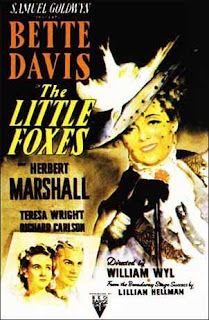 broken
her spirit and she drinks regularly. Oscar married Birdie for her
family's land and he and Ben now plan to build a cotton mill on that
land. However they are short and come to Regina for the rest of the
money, she says she will get it from Horace but she wants a larger share
than her brothers if she does. Horace refuses to give his wife the
money so the brothers concoct a plan to steal Horace's bonds from the
bank enlisting Oscar's simpleton son who works there. When Horace finds
out he doesn't tell the police instead letting the brothers take the
bonds which enrages Regina who wants to use the theft to bribe her
brothers. Just then the sickly Horace has a heart attack and Regina
leaves him instead of getting his pills. He dies and she manages to
bribe her brothers and get her larger share in the business but in the
process loses her daughter Alexandra who is upset about her father's
death and absconds with her suitor David.
broken
her spirit and she drinks regularly. Oscar married Birdie for her
family's land and he and Ben now plan to build a cotton mill on that
land. However they are short and come to Regina for the rest of the
money, she says she will get it from Horace but she wants a larger share
than her brothers if she does. Horace refuses to give his wife the
money so the brothers concoct a plan to steal Horace's bonds from the
bank enlisting Oscar's simpleton son who works there. When Horace finds
out he doesn't tell the police instead letting the brothers take the
bonds which enrages Regina who wants to use the theft to bribe her
brothers. Just then the sickly Horace has a heart attack and Regina
leaves him instead of getting his pills. He dies and she manages to
bribe her brothers and get her larger share in the business but in the
process loses her daughter Alexandra who is upset about her father's
death and absconds with her suitor David.
I would say The Little Foxes is a film you could definitely define as a 'women's film'. The male characters are either greedy (Oscar and Ben), thick (Leo) or kind but sick (Horace). In fact the character of David had to be created to add another sympathetic male to the story but even David isn't perfect and can't hold his tongue over his hatred of the Hubbard family. The three female leads all received Oscar nods again Davis plays a monstrous woman who is battling for equal rights for women but going about it the entirely wrong way. Teresa Wright's Alexandra is the film's moral compass, as Alexandra she is grown out of a childlike admiration for her mother and realises that her family isn't as perfect as she once though. While Patricia Collinge as Birdie gives a multi-layered performance of a very sweet women who is on the verge of a nervous breakdown thanks to her husband Oscar's constant berating of her. In her final scene she has a mini-breakdown and it is one of the film's best and most hear-tbreaking scenes. The sets are brilliant with Regina and Horace's house particularly lavish however this is where Davis and Wyler fell out as she didn't think that a family who had money problems would afford a place like this. Davis did eventually quit the picture but when Wyler threatened to sue her for the cost of the film she came back and finished but didn't do a slapdash job at all. The film got eight nominations but won none of them and this was another film that lost out to the inferior How Green Was My Valley. A very good melodrama it's a shame that Wyler and Davis never worked together again because this film is expertly made and brilliantly played.
 broken
her spirit and she drinks regularly. Oscar married Birdie for her
family's land and he and Ben now plan to build a cotton mill on that
land. However they are short and come to Regina for the rest of the
money, she says she will get it from Horace but she wants a larger share
than her brothers if she does. Horace refuses to give his wife the
money so the brothers concoct a plan to steal Horace's bonds from the
bank enlisting Oscar's simpleton son who works there. When Horace finds
out he doesn't tell the police instead letting the brothers take the
bonds which enrages Regina who wants to use the theft to bribe her
brothers. Just then the sickly Horace has a heart attack and Regina
leaves him instead of getting his pills. He dies and she manages to
bribe her brothers and get her larger share in the business but in the
process loses her daughter Alexandra who is upset about her father's
death and absconds with her suitor David.
broken
her spirit and she drinks regularly. Oscar married Birdie for her
family's land and he and Ben now plan to build a cotton mill on that
land. However they are short and come to Regina for the rest of the
money, she says she will get it from Horace but she wants a larger share
than her brothers if she does. Horace refuses to give his wife the
money so the brothers concoct a plan to steal Horace's bonds from the
bank enlisting Oscar's simpleton son who works there. When Horace finds
out he doesn't tell the police instead letting the brothers take the
bonds which enrages Regina who wants to use the theft to bribe her
brothers. Just then the sickly Horace has a heart attack and Regina
leaves him instead of getting his pills. He dies and she manages to
bribe her brothers and get her larger share in the business but in the
process loses her daughter Alexandra who is upset about her father's
death and absconds with her suitor David.I would say The Little Foxes is a film you could definitely define as a 'women's film'. The male characters are either greedy (Oscar and Ben), thick (Leo) or kind but sick (Horace). In fact the character of David had to be created to add another sympathetic male to the story but even David isn't perfect and can't hold his tongue over his hatred of the Hubbard family. The three female leads all received Oscar nods again Davis plays a monstrous woman who is battling for equal rights for women but going about it the entirely wrong way. Teresa Wright's Alexandra is the film's moral compass, as Alexandra she is grown out of a childlike admiration for her mother and realises that her family isn't as perfect as she once though. While Patricia Collinge as Birdie gives a multi-layered performance of a very sweet women who is on the verge of a nervous breakdown thanks to her husband Oscar's constant berating of her. In her final scene she has a mini-breakdown and it is one of the film's best and most hear-tbreaking scenes. The sets are brilliant with Regina and Horace's house particularly lavish however this is where Davis and Wyler fell out as she didn't think that a family who had money problems would afford a place like this. Davis did eventually quit the picture but when Wyler threatened to sue her for the cost of the film she came back and finished but didn't do a slapdash job at all. The film got eight nominations but won none of them and this was another film that lost out to the inferior How Green Was My Valley. A very good melodrama it's a shame that Wyler and Davis never worked together again because this film is expertly made and brilliantly played.
Saturday, 8 May 2010
Matt's Big Oscar Challenge Day 34: She's Just a Devil Woman
One good thing about this project is that it is getting me watching a lot of the older stars of the screen that I'm not really aware of for example I have become enamoured with both Charles Laughton and Lionel Barrymore's acting skills and the beauty of Claudette Colbert. Here though for the first time is Bette Davis, the main thing I know about her is that are eyes are somewhat worthy of a song, and to be fair they are quite startling. In 1939 the film Jezebel was nominated for Best Picture but it lost to You Can't Take It With You. However it also saw Davis win back-to-back Best Actress statuettes, her first win was for the film Dangerous which wasn't nominated for Best Picture so won't be watched by me in the near future. In Jezebel she plays Julie a strong-willed Southern Belle living in New Orleans who is to be married to Henry Fonda's banker Pres. Julie likes to be different riding around on a horse that Pres doesn't want her to and wearing red to a ball that she should wear white to. The scene at the ball is very effective indeed as Pres forces Julie to dance in the dress and we can see how uncomfortable she feels. Pres and Julie separate and he goes up North returning a year later with a new wife. Julie then tries to egg on new admirer Buck to quarrel with Pres but he has to leave to help his Doctor friend deal with the outbreak of yellow fever and Pres' brother ends up duelling with Buck and fatally shooting him. Pres eventually has to go to an island when he himself is diagnosed with yellow fever and Julie convinces Pres' wife that it should be Julie that goes with him and not her. The end of the film sees Pres and Julie leaving for what is essentially a leper colony.
Davis more than justifies her Best Actress win in this picture playing a character that no man dare get involved with. From the minute she rides in on her horse we know that she means trouble and she is a free-thinking woman especially for the time the film is set (1850). She owns every scene she's in and even makes Henry Fonda look inferior which is a hard task. By the end of the film you wonder why anyone would want Julie as one of her men is shot dead and the other is on his death bed. Apart from Davis' performance the most striking thing about Jezebel is the score which is always seems to imply some kind of danger or some scheming of Julie's. The supporting cast are all adequate but there is no standout this is almost a one woman show and a very effecting film however I think audiences at the time preferred the light-hearted You Can't Take It With You to this very dark and ultimately depressing tale, another great character study from William Wyler.
Subscribe to:
Posts (Atom)