Showing posts with label Mervyn LaRoy. Show all posts

Thursday, 9 April 2015

Matt's Big Oscar Challenge Days 420-422: Days of Future Past Part Six

Welcome once again to our time-travelling trip through the decades as we attempt to fill in the gaps of the challenge.

First of all apologies for jumping around the timeline a bit but at the last minute I managed to get my hands on a copy of 1931 nominee Five Star Final. Although the film was released around the same time as Trader Horn, I found that the newspaper drama felt a lot more contemporary. Mervyn La Roy's film focuses on editor Joseph Randall who finds himself under pressure to increase the distribution of his tabloid. He's talked in to producing a series of articles focusing on the twentieth anniversary of a murder committed by the notorious Nancy Voorhies. Little does he know that Nancy is now happily married and has a daughter who herself is about to tie the knot. The revelation in the papers soon spoils the family's happiness and results in both Nancy and her husband Michael committing suicide. What I initially thought was going to be a drama in the same vain as previous early nominee The Front Page turned dark very quickly. The double suicide coupled with the general reaction to the event meant that Five Star Final was one of the earliest examples of a press satire. It was quite easy to deduce that Five Star Final's origins lay on the stage however LaRoy at least went out of his way to use the cinematic techniques available to him. Most notably he employed some clever editing during a sequence in which Nancy is desperately trying to get Randall to drop the story about her family. As Randall, I thought Edward G. Robinson was brilliant as he conveyed his character's guilt perfectly and his final speech was brilliantly delivered. Although The Front Page is definitely of its time I think it holds up a lot better than the three films in the previous post and I found it to be an incredibly easy watch. It's also no surprise to learn that the film was one of the two that made Robinson a star and I'm only surprised that he hadn't been a big name before Five Star Final was released.

We now move in the right direction for probably the last 1930s film I'll review for as part of this blog. The Citadel is an interesting film that almost feels like three episodes of a miniseries featuring Robert Donat's trainee Doctor Andrew Mason. The first part of the film looks at Mason's training in a small Welsh town in which he meets resistance from the senior doctor's wife but at the same time is able to help out several villagers. The second part of the movie looks at Mason's move to a Welsh mining village and his marriage to beloved schoolteacher Christine. Once again Andrew faces opposition, this time from the miners who don't want him to change the way they've been doing things for years. Andrew refuses to punch their unfit for work cards and wants to explore the troubling coughs that the miners develop. Eventually frustrated he leaves Wales for London but he struggles to find patients for his burgeoning clinic. The final third of the film looks at Mason's corruption at the hands of the Harley Street set and the fact that he makes a lot of money from doing very little. I personally found the general structure of The Citadel to be quite frustrating as, just as one plot starting to develop, director King Vidor changed the action to another location. The one memorable moment of the film comes halfway through when Mason helps rescue several people from a collapsed mine. However, the film then gets a little dreary as we see Andrew become more and more enchanted with the superficial London lifestyle. I have to say that the point The Citadel was making was quite an obvious one and I found the ending completely anticlimactic. In fact the only thing that saved it was the central turn from Robert Donat who certainly showed qualities that would later see him cast in his Oscar-winning role in Goodbye Mr. Chips. Aside from Donat though there was very little about The Citadel that was memorable and at the end of the day it feels like yet another also-ran nominee.

But describing our next film; The Yearling as an also-ran nominee would almost be giving it too much credit as its one of the most inconsequential pieces of cinema I think I've ever seen. Set in 1878, The Yearling follows the adventures of the Baxter family - former Civil War soldier Penny, his withdrawn wife Ora and their son Jody. Throughout the film Ora's emotional state is explained away by the fact that she'd lost all of her other children and only Jody remained. I have to say if I was in Ora's position I'd be a little annoyed to as Jody is especially annoying. Films like The Yearling only work if the cute child star isn't annoying and unfortunately in this movie that isn't the case. It's particularly annoying as the majority of the film deals with Jody's relationship with a young fawn named Flag who he tries to raise. But, when the time comes to set him free, Jody doesn't take it and instead experiences proper loss for the first time. Whilst I can see what director Clarence Brown was trying to achieve with The Yearling the results are incredibly mediocre. Aside from Claude Jarman Jr's cloying performance as Jody, the cast are uniformly forgettable. Most surprising was the fact that Jane Wyman, who was so superb in Johnny Belinda, made little impression in her role as Ora. To be fair to Wyman the role didn't require much of her apart from sitting sour-faced whilst performing some menial task. Though Gregory Peck tried his best to make us warm to Penny, I found him a little too squeaky clean and didn't think he came down hard enough on his son. Surprisingly The Yearling was nominated for seven Oscars including for the performances given by Peck and Wyman. The fact it won in the colour cinematography and art direction categories leads me to believe that its main appeal to the Academy was its bright colours. Indeed, when films were primarily still shot in black and white, I'd feel that The Yearling would definitely stand out in the crowd. But it's a film that hasn't aged well and at the end of the day I don't think it would've been nominated at all were it not for the fact that it had been filmed in colour.

The only good think about watching The Yearling was the fact that it was the last Best Picture Nominee of the 1940s that I was yet to watch. To that end the next post looks at my completion of both the 1950s and 1960s.

Sunday, 5 April 2015

Matt's Big Oscar Challenge Days 417-419: Days of Future Past Part Five

After completing the first decade of the 21st century I find myself almost eighty years back in the past as I look at three more films that I've unearthed from the 1930s.

We start with a film from the 1931 ceremony in the rather controversial Trader Horn. The film itself was ground-breaking as it was the first non-documentary film to be shot on location in Africa. Trader Horn certainly makes use of this fact by including plenty of facts about the country's various wildlife population. In fact at times these scenes, some of which were shot in Mexico, felt like they were straight out of a nature documentary as lead actor Harry Carey informed the audience of the beasts' various attributes. The story, which was very slight, saw Carey's titular ivory trader take his new apprentice down the Nile whilst avoiding hungry native tribes and the brainwashed missing daughter of a missionary. At times the film would just stop and start without a lot of explanation whilst a lot of the sound recording was patchy at best. Part of the reason for this would be that a lot of the sound was re-recorded in the States although this led to suspicion that the film hadn't actually been shot in Africa at all. Trader Horn is almost more interesting for its behind-the-scenes stories including the fact that two crew members died; one eaten by a crocodile whilst the other was gored by a charging rhino. Meanwhile lead actress Edwina Booth's career was effectively ended when she contracted a disease, possibly malaria, which she took the next six years to recover from. Although viewed by modern eyes Trader Horn is quite hokey, there's no denying that it's influential in the way it shot on location. If you take into consideration that film-making was still in its infancy then director W.S. Van Dyke needs applauding for the risks he took whilst making Trader Horn. Ultimately, even though it doesn't hold up today I believe that Trader Horn's historical significance at least justifies it a place amongst its fellow best picture nominees.

Moving forward three years we have Sidney Franklin's The Barretts of Wimpole Street which essentially tells the story of how Elizabeth Barrett married Robert Browning. The majority of the film felt like a play that had simply been put on the big screen primarily as it was almost all in set in one room. The room in question was the one in which Elizabeth had been recuperating following an illness that had left her incredibly weak. The illness was being used by her despicable father Edward to keep her with him for as long as possible as he felt all of his children were deserting him. Elizabeth's redemption came through her correspondence with Browning who later appeared at the house in person and eventually convinced her that she wasn't as ill as she believed. Everything about The Barretts of Wimpole Street is pure melodrama from Herbert Stothart's overly dramatic score to the performances given by the primary cast members. Norma Shearer definitely plays to her strengths as the damsel in distress who is both subdued and rescued by seemingly stronger men. Meanwhile Frederic March is every inch the dashing hero as Browning who isn't particularly convincing as one of literature's most famous figures. Meanwhile, as Edward, Charles Laughton hams it up big time as he delivers all of his evil lines with great aplomb. If there was an image that perfectly summed up the film then it would be one of the many times that Laughton appears out of nowhere to confront one of his troublesome daughters. His arrival is coupled with ominous music whilst Laughton himself lays on an expression that just screams out villain of the piece. I think the film best demonstrates the fact that ten nominees during the 1930s was just too many especially if movies like The Barretts of Wimpole Street rank among the year's best.

I would echo that sentiment when it comes to another Frederic March vehicle, Anthony Adverse. The film is based on Hervey Allen's epic novel and is directed by the dependable Mervyn La Roy. Anthony Adverse is essentially a nuts and bolts literary adaptation filled with overblown exterior shots and cloying heart-to-hearts between characters. The titular character initially grew up in an orphanage after his mother's despicable husband dropped him off after learning he was the product of an affair. As chance would have it, Anthony ends up working for and living with his grandfather who knows of his identity but never informs him of it. As Anthony grows up, and is eventually portrayed by March, he falls in love with Angela; the daughter of the housekeeper. Angela and Anthony eventually marry but are separated soon after as he goes to Cuba and then Africa where he attempts to recoup his family fortune by participating in the slave trade. If this doesn't sound far-fetched enough then the film climaxes with Anthony learning that opera singing Andrea is now Napoleon's mistress but not before giving birth to her husband's baby. There were only a couple of things I liked about Anthony Adverse the first being an enthralling carriage ride that climaxed in an unfortunate servant plummeting to his death. Additionally I felt that Claude Rains delivered the best performance of the bunch as the despicable Don Luis who attempts to bring down Anthony several times as revenge for his mother's infidelity. Unfortunately March and female lead Olivia De Havilland don't make much of an impression and the adapted screenplay makes the whole plot feel even more overblown than it is. Anthony Adverse's only lasting legacy is the fact that it made Oscar history by containing the winner of the first ever Best Supporting Actress Award. The performer in question was Gale Sondergaard who played Don Luis' partner in crime, devious ladies' maid Faith. Whilst Sondergaard did thrive in her handful of scenes, I don't think she did that much to warrant being awarded an Oscar. Thankfully the recipients of the prize only got better from here on in and I would say that Anthony Adverse was another nominee that didn't really deserve its place amongst the Best Picture contenders.

I will return soon with more films from the 1930s and 1940s.

Sunday, 25 January 2015

Matt's Big Oscar Challenge Days 372-374: Days of Future Past Part Four

We rewind once again and this time embark on a journey through three films that were nominated for Best Picture during the 1940s.

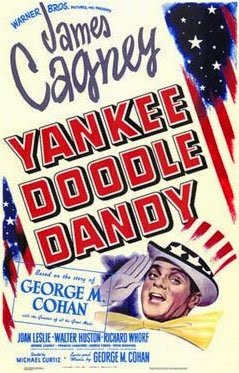
We kick off with an Oscar favourite; a biopic in the form of Yankee Doodle Dandy which focused on the life of composer and showman George M. Cohan. As somebody who wasn't particularly familiar with the name the only thing that drew my eye to the film was the title itself. Indeed, it was later revealed to me that Cohan wrote a number of patriotic songs including 'Over There' which was played to honour the men serving in the First World War. Yankee Doodle Dandy's patriotic nature meant that it had a lot in common with the last 1940s film I watched, Sergeant York. Both were flag-waving endeavours, both starred Joan Leslie as the female lead and both won the award for Best Actor. However I felt that James Cagney's portrayal of Cohan was miles better than Gary Cooper's turn in Sergeant York the previous year. Cagney captivated the screen throughout proving himself to be a fine theatrical presence but also was able to add more pathos to the role when the script required it. The musical numbers that were scattered throughout Yankee Doodle Dandy helped me to understand just why Cohan deserved to have a whole film devoted to him. If I have once criticism of Yankee Doodle Dandy, it's the linear approach that screenwriters Robert Buckner and Edmund Joseph employ. The film sees Cohan narrate his life story to President Roosevelt in a manner that I found quite dry although the musical aspect of the piece more than made up for it. Ultimately I found Yankee Doodle Dandy to be a rather easy watch which was bolstered by a blistering turn from James Cagney.
Nominated alongside Yankee Doodle Dandy in 1943 was Kings Row, a film based on the novel by Henry Bellamann about a number of youngsters growing up in a small town. The film begins with meeting the five characters we'll be spending time with as schoolchildren, which in a way helped to understand their motivations as we saw them grow up in prior years. Among the cast of twentysomethings were Ann Sheridan, Betty Field and a certain whipper-snapper by the name of Ronald Reagan. In fact Reagan's performance as the initially privileged Drake McHugh was possibly the best of the five turns given by the younger cast members. I believe that that has something to do with the fact that McHugh has the most to deal with from losing his inheritance to having his legs lopped off by a sadistic surgeon. As you can tell by that description alone there's a lot of bleak moments in Kings Row including suicide, murder and mental illness. I feel the melodramatic tone of Kings Row was what put me off it especially seeing as the three female members of the cast gave incredibly hammy turns. Erich Wolfgang Korngold's score was similarly overbearing and definitely left little to the imagination. At the same time I can't say that I wasn't moved by anything that happened in Kings Row and I discovered that I'd become invested in at least two of the characters. However, I ultimately believe that Kings Row will be one of the films I've watched throughout this challenge that will soon fade from my memory in the coming weeks.

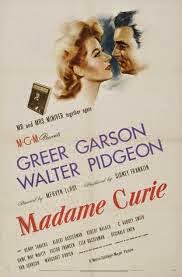
Yankee Doodle Dandy and Kings Row ended up both losing the Best Picture prize to quaint English war yarn Mrs. Miniver which would also see Greer Garson pick up the Lead Actress award. One year later Garson would pair up with her Mrs Miniver co-star Walter Pidgeon for yet another biopic in which would see her portray the brilliant Marie Curie. However the lead characters of Marie and Pierre Curie are the only brilliant things in this really stale and dull biopic. If I didn't know any better I would've thought that Madame Curie had been made in the early 1930s rather than the mid-1940s. There are plenty of things wrong with Madame Curie not least its script which was ridiculously expositional. I wasn't surprised to learn that the script had gone through many rewrites after original scribe Aldous Huxley left the project in 1938. Rather than feeling like a cinematic release, Madame Curie looks like it's been cobbled together as an educational film to inform America's schoolchildren about the discovery of radium. After winning Best Actress the prior year, it appeared as if Greer Garson was exhausted from all the awards ceremonies as she appeared to be simply going through the motions throughout Madame Curie. Walter Pidgeon was slightly better in his role as Pierre; but the pair showed none of the excellent chemistry they shared in Mrs. Miniver and Blossoms in the Dust. One thing you could say in Madame Curie's favour is that it's a thorough retelling of Pierre and Marie's life and work together so if you wanted to know their story this is probably a good starting point. But, apart from being an educational tool, there's very little praise I can heap onto a film which I struggled to watch from beginning to end.

Next time we return to the 21st century and go on a marathon of Best Actor winning pictures.

Thursday, 22 March 2012

Matt's Big Oscar Challenge Day 165: Burning Love


We travel from the blood-soaked fields of World War 2 to Ancient Rome under Emperor Nero for our penultimate 1950s film Quo Vadis. The film is very similar to previous entries on this list such as The Ten Commandments and The Robe in so much as they try to utilise the new technicolor methods to create a vivid story while at the same time referencing parts of The Bible. In this case we have Rome just after the death of Jesus, although Peter features quite predominantly throughout, where the Christians are living in private and here are represented by Deborah Kerr's Lygia. Playing opposite Kerr is Robert Taylor as Marcus Vinicius a returning Roman soldier whose uncle Petronius is one of Nero's most trusted advisors and who becomes intrigued with Christianity through is infatuation with Lygia. When the slightly crazy Nero, played by the brilliant Peter Ustinov, decides to burn Rome and blame the Christians people start to believe that he has gone loopy while Potronious goes so far as to kill himself. Both Lygia and Marcus are arrested and then are married by Peter before he himself is crucified upside down. Nero's wife, who has been knocked back by Marcus, decides to teach the couple a lesson by setting Lygia up to be gored by a bull in the coliseum and chaining Marcus up so he has to watch. Eventually Nero is overthrown and has one of his slaves kill him as he is too cowardly to take his own life so the film ends with Lygia and Marcus able to leave Rome as we see Peter's staff and here his words being spoken to those who are lucky enough to have survived Nero's tyrannical reign.

Always when writing these reviews I try and think what I will most remember about this film after having watched it and in the case of Quo Vadis there are two points. Firstly the epic scale of it all as this is very similar to a Cecil B Demille picture complete with an entire sequence with Rome burning to the ground and then another scene featuring live animals trying to attract Nero's prisoners in the coliseum. The other memorable aspect of Quo Vadis is Peter Ustinov's performance as Nero, for which he was nominated for Best Supporting Actor, playing this evil man in quite a child-like manner changing his ideas on a whim and often being manipulated by his devious wife whom he finally cottons onto and kills just before the end scene. It is Ustinov you always look forward to seeing because Robert Taylor is such a wooden actor and you don't believe for one minute that he is the great Roman soldier in fact he just seems like another beefcake actor while Deborah Kerr here is on poor form possibly being ill-served with a role in which she doesn't do much than follow other men's leads. So all in all this is a colourful romp through Ancient Rome which lasts far too long, its running time is almost three hours, but has a great performance from Ustinov. While this isn't a great film it does highlight a time where film-makers were using techniques to recreate these epic stories so in those terms Quo Vadis is an interesting film to watch if not just in a historical context.