Showing posts with label James Cagney. Show all posts

Sunday, 25 January 2015

Matt's Big Oscar Challenge Days 372-374: Days of Future Past Part Four

We rewind once again and this time embark on a journey through three films that were nominated for Best Picture during the 1940s.

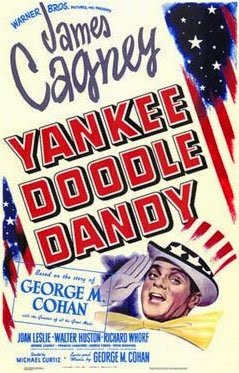
We kick off with an Oscar favourite; a biopic in the form of Yankee Doodle Dandy which focused on the life of composer and showman George M. Cohan. As somebody who wasn't particularly familiar with the name the only thing that drew my eye to the film was the title itself. Indeed, it was later revealed to me that Cohan wrote a number of patriotic songs including 'Over There' which was played to honour the men serving in the First World War. Yankee Doodle Dandy's patriotic nature meant that it had a lot in common with the last 1940s film I watched, Sergeant York. Both were flag-waving endeavours, both starred Joan Leslie as the female lead and both won the award for Best Actor. However I felt that James Cagney's portrayal of Cohan was miles better than Gary Cooper's turn in Sergeant York the previous year. Cagney captivated the screen throughout proving himself to be a fine theatrical presence but also was able to add more pathos to the role when the script required it. The musical numbers that were scattered throughout Yankee Doodle Dandy helped me to understand just why Cohan deserved to have a whole film devoted to him. If I have once criticism of Yankee Doodle Dandy, it's the linear approach that screenwriters Robert Buckner and Edmund Joseph employ. The film sees Cohan narrate his life story to President Roosevelt in a manner that I found quite dry although the musical aspect of the piece more than made up for it. Ultimately I found Yankee Doodle Dandy to be a rather easy watch which was bolstered by a blistering turn from James Cagney.
Nominated alongside Yankee Doodle Dandy in 1943 was Kings Row, a film based on the novel by Henry Bellamann about a number of youngsters growing up in a small town. The film begins with meeting the five characters we'll be spending time with as schoolchildren, which in a way helped to understand their motivations as we saw them grow up in prior years. Among the cast of twentysomethings were Ann Sheridan, Betty Field and a certain whipper-snapper by the name of Ronald Reagan. In fact Reagan's performance as the initially privileged Drake McHugh was possibly the best of the five turns given by the younger cast members. I believe that that has something to do with the fact that McHugh has the most to deal with from losing his inheritance to having his legs lopped off by a sadistic surgeon. As you can tell by that description alone there's a lot of bleak moments in Kings Row including suicide, murder and mental illness. I feel the melodramatic tone of Kings Row was what put me off it especially seeing as the three female members of the cast gave incredibly hammy turns. Erich Wolfgang Korngold's score was similarly overbearing and definitely left little to the imagination. At the same time I can't say that I wasn't moved by anything that happened in Kings Row and I discovered that I'd become invested in at least two of the characters. However, I ultimately believe that Kings Row will be one of the films I've watched throughout this challenge that will soon fade from my memory in the coming weeks.

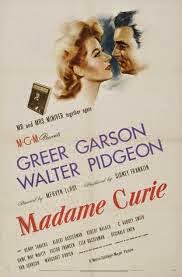
Yankee Doodle Dandy and Kings Row ended up both losing the Best Picture prize to quaint English war yarn Mrs. Miniver which would also see Greer Garson pick up the Lead Actress award. One year later Garson would pair up with her Mrs Miniver co-star Walter Pidgeon for yet another biopic in which would see her portray the brilliant Marie Curie. However the lead characters of Marie and Pierre Curie are the only brilliant things in this really stale and dull biopic. If I didn't know any better I would've thought that Madame Curie had been made in the early 1930s rather than the mid-1940s. There are plenty of things wrong with Madame Curie not least its script which was ridiculously expositional. I wasn't surprised to learn that the script had gone through many rewrites after original scribe Aldous Huxley left the project in 1938. Rather than feeling like a cinematic release, Madame Curie looks like it's been cobbled together as an educational film to inform America's schoolchildren about the discovery of radium. After winning Best Actress the prior year, it appeared as if Greer Garson was exhausted from all the awards ceremonies as she appeared to be simply going through the motions throughout Madame Curie. Walter Pidgeon was slightly better in his role as Pierre; but the pair showed none of the excellent chemistry they shared in Mrs. Miniver and Blossoms in the Dust. One thing you could say in Madame Curie's favour is that it's a thorough retelling of Pierre and Marie's life and work together so if you wanted to know their story this is probably a good starting point. But, apart from being an educational tool, there's very little praise I can heap onto a film which I struggled to watch from beginning to end.

Next time we return to the 21st century and go on a marathon of Best Actor winning pictures.

Tuesday, 2 August 2011

Matt's Big Oscar Challenge Day 147: Going Stir Crazy


Basically all of the films on this list are coming from either LoveFilm or various YouTube sources so if I can't reference a movie on either of those then I probably won't get to watch it. A nominee from the 1956 ceremony, Mister Roberts, was one such film which I had already banished to the unwatchable pile so imagine my surprise when it suddenly appeared on the T.V. listings for a Channel Five Saturday afternoon. Thanks to that I was able to watch the film whcih it turned out was a comedy-drama set during the final days of World War 2 on a naval Cargo Ship. To me it reminded me of The Caine Mutiny which I recently watched as it was about mundane life on a ship featuring a quartet of impressive performance from big names - Henry Fonda as Mister Roberts, James Cagney in his final MGM performance as the tyrannical Captain, William Powell in his final performance as the world-weary ship Doctor and Jack Lemmon winning the Supporting Actor Oscar here as the jovial ensign in charge of morale and laundry. For me this was one of Henry Fonda's best turns, apart of course from 12 Angry Men, playing a man who is desperate to serve properly and writes weekly letters to be let off the ship however Cagney's Captain sees him as an asset so keeps him around and he is well liked by his crew members whom he doesn't impose strict rules on. As time goes on the Captain is frustrated by Roberts and feels he isn't respecting him so he grants the crew their leave as long as Roberts tows the line and agrees with his orders. When the crew finally find out about this they decide to forge a letter from the Captain and get him transferred from the ship and he finally gets to serve in Japan the film tragically ends with the news that Roberts died when a suicide bomber killed all the crew of his new ship. While the death of your main character would usually be a downer in the case of Mister Roberts it was slightly more poignant and uplifting as he died getting what he always wanted to do and that was serve properly during the war.

I have to say I really enjoyed Mister Roberts mainly how easily it was able to demonstrate how not all men had heroic jobs during the war some of them just were there to ship cargo from one port to another and weren't happy about it. There are a lot of comic segments throughout the film demonstrating this including one where the men try and spy nurses on a nearby island while they are in the shower while one long scenes sees Fonda, Powell and Lemmon try and knock up some home-made scotch. These segments are transposed with some truly heart-wrenching moments such as Cagney opening up to Fonda about his life before he became a captain which was fairly reminiscent of Bogart's speech to his crew in The Caine Mutiny and also the scene in which Fonda goes crazy after he realises that he might not serve when peace in Europe is announced. Lemmon's performance is indeed great combining his comic timing with more dramatic moments of clarity personally his ways of getting revenge over a captain he's scared of are particularly memorable. All in all a great quartet of performances coupled with John Ford's skilled direction and a great script means that Mister Roberts is one of the better Oscar nominees never to take home the prize.

Tuesday, 20 April 2010

Matt's Big Oscar Challenge Day 21: Cagney and Navy

As someone who associated James Cagney with gangster films I was surprised to see him as Bottom in the 1936 nominee A Midsummer Night's Dream. Here Comes the Navy is another Cagney film which sees him do comedy. This film sees Cagney play Chesty O'Connor a construction worker who begins a feud with Biff Martin, a navy man who steals O'Connor's girlfriend. To get back at Martin Chesty randomly decides to also join the navy, there is an interesting sequence which sees nine months of naval training condensed into about three minutes. The main story however is about Biff and Chesty's feud which intensifies when Chesty starts dating Biff's sister. Chesty is court-martialled after going AWOL to see her but redeems himself when he injures himself to save the ship during a training mission gone wrong. But the higher-ups decide that Chesty doesn't want to stay on the ship so transfer him to the aircrafts where in a bizarre twist of events involving a parachute, he ends up saving Biff's life and then becomes Biff's superior and brother-in-law when he marries his sister.

Describing Here Comes the Navy as a comedy may be a bit of a stretch because I didn't really laugh that much. Cagney's character is a bit odd always wanting to fight and I still didn't understand the motivation to join the navy to get back at someone who will then become his superior. But this must be a comedy as Chesty has a comedy sidekick in a simpleton named Droopy Mullins who is obsessed by getting his mother false teeth so she can eat meat and resume singing her favourite song, yes that really is a subplot in this film. But there's something inherently likeable and charming about this film, Cagney is an engaging presence and everything is kept quite light. While its Oscar nomination is dubious, it was only nominated for Best Picture and didn't really have a chance against It Happened One Night. Overall this isn't a very good advert for the navy who come across as stiff and dull but it's still an entertaining movie.

Wednesday, 7 April 2010

Matt's Big Oscar Challenge Day 11: Getting a Bit Bard


In the interest of getting though this challenge I decided to group together two films which have one thing in common - Mr Bill Shakespeare. Yes two Shakespeare adaptations - A Midsummers Night's Dream and Romeo and Juliet, were nominated in 1936 and 1937 respectively. First of all A Midsummers Night's Dream (the fourth of 1936's nominees) I am to watch which I was very impressed with. For a film from 1935 I was impressed by the overall design of the picture and the quality of some of the scenes especially those involving the fairies. Despite losing out in the Best Picture (and Best Assistant Director) categories the film did pick up two awards for cinematography and editing and I have to say it deserved both. I was utterly enthralled by some of the sequences involving Puck when he transformed into a cloud of smoke, even though Mickey Rooney's acting completely annoyed the hell out of me. Star of the show surprisingly was James Cagney, better known for his roles in gangster movies here Cagney played Bottom - possibly the best known character for getting turned into a donkey. Of course his performance is overblown but that's what the character has to be he is of course the comic relief. The majority of the story as all English graduates know focuses on Hermia due to marry Demetrius but really in love with Lysander the three, along with Demetrius' admirer Helena are trapped in the woods and at the mercy of the spells of Puck and fairy lord Oberon. I felt this part of the story lacked panache, it is quite boring and the two actors playing Lysander and Demetrius didn't really have a lot going for them and neither seemed to be of the leading man calibre that I believe the roles need. The other big name in the cast is Olivia De Havilland the best of the quartet - her Hermia is kind of strong yet vulnerable but I didn't feel that she should really be paired with either of the men who were pursuing her. The whole thing was enjoyable enough although I felt the pace lagged in places mainly during, fairy queen, Titania's singing and the final play performed by Bottom and co. Overall enjoyable and I thought it was better than a lot of the films in the Oscars list from this year (Captain Blood, The Informer)


So we continue onto the second helping of the Bard and George Cukor's Romeo and Juliet another film that was nominated for four Oscars but failed to pick up any. Twice losing out to The Great Ziegfeld both in Best Picture and Best Actress categories, I apologise if I was a little harsh on Luise Rainer in my previous post but her performance in The Great Ziegfeld was certainly better than Shearer's Juliet. While Norma Shearer is a fine actress I found her a little flat as Juliet and much too old to play the part. Similarly Leslie Howard's age is a problem in his performance as are his looks which I thought were rather effeminate and couldn't buy his fight scenes. Luckily there are some choice support performances which keep the film flowing along. John Barrymore as Mercutio is brilliant playing it more for laughs as an aging playboy thinking that he is still a hit with the ladies. While Basil Rathbone pops up again to flail a sword around as quite a villainous Tybalt. Although I didn't think he was as great as Barrymore, it was Rathbone who got a Best Supporting Actor nomination. Although it is a good story to tell I think the film dragged out and wasn't particularly inventive and very stagy, I was really only impressed by the masquerade ball scene, I didn't really feel anything when the lovers die or when Mercutio is stabbed and just thought it was just a bit cold and didn't offer anything particularly cinematic. So at the moment with this and Three Smart Girls, The Great Ziegfeld was definitely the right choice to win that year.